Holiday Calendar

Car-free Sunday

Next celebratedTuesday, September 22, 2026

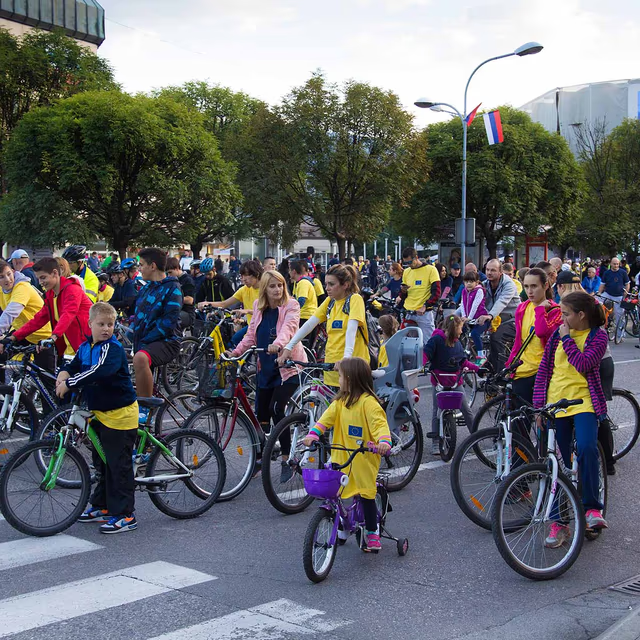
For one Sunday every September, Brussels shuts its entire region to motor traffic, drops every bus, tram and metro fare to zero, and hands the road to pedestrians and cyclists.

Countdown to the day
--DAYS
--HRS
--MIN
--SEC
Have an update or spot an error?
YEARLY DATESeptember 22
OBSERVED INInternationally
CATEGORYNature
SUBCATEGORYConservation
ORIGIN

Event Origin

FOUNDING ENTITY
Not documented
FIRST OBSERVED
1956
Nobody planned a holiday. The oil ran short and the cars came off the road.
HOW THE HOLIDAY CAME TO BE

A fuel shortage emptied the roads first.

The car-free Sunday began as emergency fuel rationing rather than an environmental campaign. Belgium held its first on 25 November 1956, after the Suez Crisis cut Middle East oil supplies to Europe. A second series followed the 1973 embargo, and the Netherlands banned Sunday driving from 4 November 1973 to 6 January 1974, exempting only holders of a special permit. The annual observance came much later, when the European Commission built a campaign around 22 September in 2000 and the Brussels-Capital Region made the day region-wide in 2002.

INTRO

The day the cars stopped and the dust rose

On the third Sunday of September 2009, Brussels switched off its traffic. Cars were banned, the streets filled with bicycles, and the city's monitors recorded one of the highest particulate readings of the whole year.

That is not a scandal, and it is not an argument against the day. It is the most interesting thing about it. Most of the fine dust hanging over the city that morning had never been in a Brussels exhaust pipe.

One measurement did move the way everyone expected. Black carbon, the diesel soot that comes straight off the road, fell the moment the cars stopped and climbed again the moment they came back.

A car-free Sunday, it turns out, is a rather precise instrument. It cannot clear the sky. It can show you exactly which part of the sky belongs to you.

Advertisement
ORIGINS

Car-free Sunday history

CHAPTER 01

A crisis, not a cause

The first car-free Sunday had nothing to do with clean air. On 25 November 1956, the Suez Crisis, a conflict over the ownership of and access to the canal, had sharply cut the oil route from the Middle East into Europe. Belgium's answer was to take the cars off the road for a day.

It was rationing, not a festival. And it would come back whenever the oil did not.
CHAPTER 02

Ten weeks of empty motorway

In the autumn of 1973 the taps closed again, this time over support for Israel in the Yom Kippur War. The Dutch cabinet under Den Uyl banned Sunday driving from 4 November 1973 to 6 January 1974. Only drivers holding a special permit could move.

The photographs the Dutch National Archives keeps from those Sundays are all about what is missing. An open motorway with nothing on it. A horse-drawn carriage and a cyclist where the traffic should be.

It failed on its own terms. The archive's verdict is blunt: the hoped-for petrol saving never arrived, because traffic simply swelled on Saturdays and on Sunday nights instead. After ten weeks the bans were withdrawn, and petrol rationing lasted barely a month.

CHAPTER 03

How a shortage became a Sunday out

Voluntary versions crept back from 1982, small and municipal. The European Commission gave them a date in 2000, building a campaign around 22 September. The first Belgian attempt was a flop: only three of Brussels' 19 communes earned the European label at all.

Two years later the region tried the opposite of a pilot. In 2002 all 19 communes closed together, and the co-ordinators got the blessing of every one of the region's mayors without difficulty.

The meaning had inverted completely. The same empty street that once meant a country was short of oil now meant a city could spare one.

TIMELINE

Timeline

Suez empties the roads

Belgium holds its first car-free Sunday on 25 November, after the Suez Crisis cuts the flow of Middle East oil into Europe.

The embargo returns

The Netherlands bans Sunday driving from 4 November and Belgium follows on 18 November. Only drivers with a special permit are exempt.

Ten weeks and no fuel saved

The Dutch ban ends on 6 January without delivering the petrol saving it was imposed for. Belgium's last Sunday, on 13 January, is cut short.

The first voluntary one

Zondag Zonder, run by Veilig Verkeer Vlaanderen on 16 October, draws 120 of Flanders' 318 municipalities into a low-car Sunday with no oil crisis behind it.

Europe picks a date

The European Commission launches its In town, without my car campaign and fixes 22 September as the car-free day. Belgium takes part for the first time.

A whole region closes

Brussels shuts its whole region to traffic for the first time, and the day becomes annual from here.

BY THE NUMBERS

Car-free Sunday by the Numbers

19
Brussels communes closed to traffic
62%
NO2 drop at Brussels' Kunst-Wet station vs an average Sunday
24 dB(A)
Noise fall beside the E40 vs the previous Sunday
76%
Brussels residents backing the 2002 edition

WHY THIS DAY MATTERS

Why We Love Car-free Sunday

Experiment

You cannot simulate a city with its engines off. You have to turn them off.

Few occasions let anyone measure a European capital with its main local pollution source switched off. Belgium's environment agencies run the comparison edition after edition, station by station, against an ordinary Sunday and against a weekday. The day produces evidence a model can only estimate.

Honesty

Its own organisers argue with it

The Brussels citizens' federation that co-ordinated the day wrote plainly that a car-free Sunday is not really an awareness campaign for sustainable mobility, because a Sunday does not touch the weekday trip to work or school. They chose Sunday anyway, for the family day it makes, and have pushed for weekday editions ever since.

GOOD TO KNOW

Surprising facts about Car-free Sunday

People picnicked on the motorway

With the carriageways empty in 1973, Dutch cyclists, roller-skating children and picnicking teenagers went out onto the motorways, where they were not allowed either. The National Archives holds the photographs.

The second Sunday came for the mopeds too

A week into the 1973 Belgian bans the rules tightened, and mopeds had to stay off the road as well. In the Netherlands, bicycle dealers did a roaring trade.

Ostend's hoteliers threatened to march on Brussels

Coastal hospitality businesses lost their day-trippers and said so loudly. The pressure worked: the last car-free Sunday of that winter, on 13 January 1974, ended at 8pm instead of 3am.

52,847 people got to a football match anyway

Belgium's first car-free Sunday of the 1970s, 18 November 1973, was also the day the Netherlands played Belgium in a decisive World Cup qualifier in Amsterdam. The Olympic Stadium still filled, thousands arriving by train, and the match finished goalless.

It got too popular for its own pavements

By 2004 the Brussels organisers judged the city centre a victim of its own success. Tens of thousands of cyclists had taken the streets, and pedestrians were being squeezed out by the new dominant road user.

GOOD TO KNOW

Car-free Sunday Around the World

Netherlands

A national ban rather than a city event. From 4 November 1973 to 6 January 1974 nobody could drive a private car on a Sunday without special permission, and on 31 October motorists were collecting their permit forms at an ANWB office.

United Kingdom

The largest Car Free Day London had held closed 20 kilometres of road around Tower Bridge, London Bridge and the City on Sunday 22 September 2019. Bank Junction became a car-free festival space for the first time, with a hedge maze in Cheapside and a re-enactment of the 1381 Peasants' Revolt at the Tower.

Colombia

Bogota does weekly what Europe does annually. The Ciclovia opens a 127.69 kilometre circuit of the city's main roads, 7.05 kilometres of it dedicated cycle track, from 7am to 2pm every Sunday and public holiday of the year.

Those who participate in London's car free day will hopefully get a glimpse of the future, what our great city can look and feel like without the intrusion of vehicles. Noise and air pollution will dissipate, and we will once again be able to hear the birds sing and children laugh.
Professor Frank Kellyon behalf of King's College London's Environmental Research Group

GET INVOLVED

How to Celebrate Car-free Sunday

EDITOR'S PICK

Find out whether your city runs one

The date is not fixed to a weekday everywhere, so check locally before you plan. Brussels publishes its own, and the 2026 edition falls on Sunday 20 September across the whole region.

RIDE

Ride the free transit while it lasts

Where the day is region-wide, the fare box usually closes with the roads. In Brussels every bus, tram and metro is free for the day, which makes it the cheapest possible afternoon out.

WALK

Walk a road you are never allowed to walk

The point of the day is the surface itself. Pick a junction or a bridge you normally only cross at speed, and stand in the middle of it while you can.

LOOK

Look up what your own air did

Belgium's environment agencies publish the station-by-station comparison after each edition. Reading the numbers for a street you know turns an afternoon out into something you can argue with.

BORROW

Borrow Bogota's habit instead of waiting a year

Nothing requires a car-free Sunday to be annual. Bogota reopens its 127.69 kilometre circuit to people on foot and on bikes week after week, which is the same idea at a completely different frequency.

Test your knowledge

How well do you know Car-free Sunday?

1 / 8

What caused the first car-free Sunday?

Answer

No public-holiday or day-off status was found for it. In Brussels it is a regional traffic measure, with a published list of exempt vehicles and an application process for individual and company permits.

COLOPHON

Sources

How we know what’s on this page. References, not endorsements.

11sources
8primary records
8independently dated
Primary records
Nationaal Archief
Autoloze zondag in Nederland (1973)
The Dutch national archive's record of the Sunday driving ban of 4 November 1973 to 6 January 1974, its permit exemption, the empty-motorway photographs it holds, and its failure to save fuel.
View source
City of Brussels2026
Car Free Sunday in Brussels on 20 September 2026
The operating rules of the modern observance: the whole Brussels-Capital Region closed from 9:30am to 7pm, free public transport, the 30 km/h exempt-vehicle list, and the permit process.
View source
IRCELINE2017
Autoloze zondag
The Belgian Interregional Environment Agency's monitoring page, explaining why nitrogen oxides and black carbon fall sharply on a car-free Sunday while total particulate mass barely moves, and correcting the reading that the day causes more pollution.
View source
Brussels Environment23 September 2024
Brussel ademt dankzij de Autoloze zondag
The agency's measured results for the 2024 edition, including nitrogen dioxide down 62 percent at the Kunst-Wet station against an average Sunday and noise falls of 17 to 24 dB(A) beside the E40 and E411.
View source
Forum geografic2011
Observation of Unusual High Particulate Mass and Number Concentration during Traffic Ban Hours of the 2009 Car Free Sunday in the Brussels Urban Area
Peer-reviewed observation that particulate mass and number peaked at one of the year's highest values during the 2009 traffic ban, with black carbon the only component that kept falling.
View source
Mayor of LondonAugust 2019
One month to go until London's biggest ever Car Free Day celebrations
The Greater London Authority's account of the Sunday 22 September 2019 event, with 20 kilometres of closed roads around Tower Bridge, London Bridge and the City, and the quotation from Professor Frank Kelly.
View source
BRAL vzw21 September 2023
Een terugblik op de Autoloze zondag
A year-by-year history by one of the day's two regional co-ordinators, covering the European Commission's 2000 campaign, the 2002 region-wide breakthrough with all 19 mayors and 76 percent approval, and the organisers' own doubts about what a Sunday changes.
View source
Bogota city portal
Horarios y rutas de la ciclovia bogotana los domingos y festivos
The city's own description of the Ciclovia, running 7am to 2pm every Sunday and public holiday over a 127.69 kilometre circuit of which 7.05 kilometres is dedicated cycle track.
View source
Additional coverage
FOR MARKETERS & CREATORS

Turn every day into a moment your audience actually shows up for.

8.4M
Monthly readers
5K+
Holidays tracked