Holiday Calendar

National Croissant Day

Next celebratedSaturday, January 30, 2027

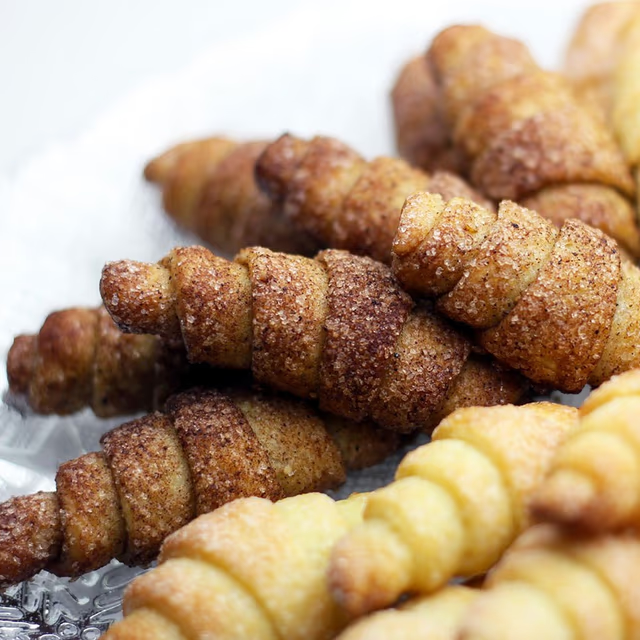
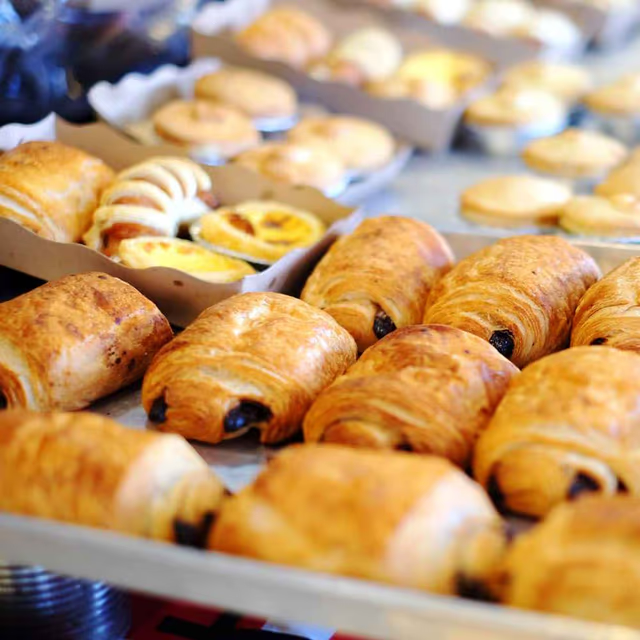
National Croissant Day takes the pastry you usually eat in a hurry and slows it down for a morning. Order one fresh from the oven and pull it apart in layers rather than cutting it.

Countdown to the day
--DAYS
--HRS
--MIN
--SEC
Have an update or spot an error?
YEARLY DATEJanuary 30
OBSERVED INUnited States
CATEGORYFood
SUBCATEGORYBaking
ORIGIN

Community Origin

FOUNDING ENTITY
Not documented
FIRST OBSERVED
Not documented
HOW THE HOLIDAY CAME TO BE

A day America keeps for an imported pastry.

No founder, sponsor or establishing record has been located for National Croissant Day. It is absent from the Federal Register and from HathiTrust's digitised run of Chase's Calendar of Events, whose volumes there span 1961 to 2007.

+ Know the story? Submit a founder Help us complete this holiday
INTRO

America met the croissant in a freezer

In French, the word croissant named the symbol of the Turkish empire long before it named anything you could eat. The Trésor de la langue française dates that sense to 1674 and the pastry sense to 1863. National Croissant Day belongs to a thing whose name arrived nearly two centuries late.

The word itself is older than either. French had already attached it to crescent-shaped objects by about 1260, centuries before a dictionary recorded anyone eating one.

That gap is the pattern, not the exception. The croissant keeps turning out to be later, and more borrowed, than its reputation suggests.

Advertisement

DEALS & OFFERS

2026’s deals have wrapped

See who celebrated this year, and browse offers from past years.

ORIGINS

Croissant Day history

INTRODUCTION

In 1838 or 1839, depending on the account, an Austrian named August Zang opened a Viennese bakery at 92 rue de Richelieu in Paris. He sold Vienna bread and the kipfel, the Austrian crescent roll the croissant descends from. It was the first Viennese bakery in the city.

For a long while the pastry stayed foreign. Smithsonian writes that as recently as the 19th century the French treated the croissant as a foreign novelty, sold only in special Viennese bakeries in the pricier parts of the city. Imitators moved faster than the reputation did: at least a dozen makers of Viennese bread were working in Paris by 1840, according to the journalist Hervé de Kerohant.

CHAPTER 01

The dough that made it French

The shape crossed the border intact. The dough did not. Jim Chevallier, an independent scholar and the author of a book on croissant history, puts the change in one line: the croissant "began as the Austrian kipfel but became French the moment people began to make it with puffed pastry, which is a French innovation."

That change was slow to reach print. The Institute of Culinary Education dates the first French croissant recipe to 1915, when Sylvain Claudius Goy folded butter into a yeast dough instead of the brioche-style dough Zang's shop had used.

CHAPTER 02

How it crossed the Atlantic

America met the croissant frozen. Sara Lee brought a frozen croissant to the United States in 1981, and it soon outsold the company's pound cakes.

The chains were not far behind. By 1984 a New York Times article could announce that the Americanization of the croissant had begun, and Burger King's Croissan'wich was already turning up in California newspaper advertising, in a Press Democrat notice that offered flame-broiled burgers, a salad bar and a drive-through in the same breath.

The holiday came along without a signature. Its earliest mention anywhere in HathiTrust's collection sits in a 2008 volume of a Colorado Springs monthly for activity professionals in retirement communities.

WHY THIS DAY MATTERS

Why We Love National Croissant Day

SCALE

1.8 billion croissants through French bakeries and baking terminals, 2021.

Trade research reported by L'Hôtellerie Restauration put French croissant consumption at 1.8 billion in 2021, sold through bakery-pâtisseries and baking terminals. The day is American, but the appetite it points at is not.

CRAFT

Lamination is the whole difference

A croissant is a yeast dough with butter folded into it over and over, a process the Institute of Culinary Education describes as creating thin layers. The folding is what makes the pastry, and the crescent is only its outline.

INDUSTRY

As many as half are industrially made

Smithsonian reports that as many as half the croissants and other pastries sold in France's 30,000 boulangeries are industrially produced. So the croissant in front of you is not automatically the work of the shop selling it.

TIMELINE

Timeline

A Viennese bakery opens in Paris

August Zang opened the city's first Viennese bakery at 92 rue de Richelieu, selling Vienna bread and the kipfel; some accounts date it to 1839.

Goy's laminated croissant recipe

The Institute of Culinary Education credits Sylvain Claudius Goy with the first French croissant recipe, built on a laminated yeast dough rather than a brioche-style one.

France answers fast food with croissants

TIME reported that French counter-service chains were selling croissants against the imported burger, and named Croissanterie as the first of them.

Sara Lee freezes the croissant

Sara Lee brought a frozen croissant to America, and it soon outsold the company's pound cakes.

The Croissan'wich reaches the papers

Burger King's Croissan'wich appeared in California newspaper advertising, the earliest instance the state's digitised newspaper collection holds.

MYTH VS FACT

Common Misconceptions

The myth

The croissant was created in Vienna in 1683 to mark the defeat of the Ottoman siege, its shape copied from the crescent on the Ottoman flag.

The truth

Smithsonian reports that the kipfel, the Austrian crescent roll the croissant descends from, existed long before that siege. Chef Jürgen David, an Austrian native and the Institute of Culinary Education's director of pastry research and development, says of the siege stories: "These stories are almost certainly untrue."

The myth

Marie Antoinette brought the croissant to France from Vienna.

The truth

The Institute of Culinary Education says the story is widely repeated but that historians have found little evidence to support it, and Smithsonian reports that the food historian Jim Chevallier sees no evidence for it either.

The myth

A French shop with boulangerie over the door makes everything in the window on the premises.

The truth

Article L122-17 of the Code de la consommation reserves boulanger and boulangerie for shops that knead, ferment, shape and bake their bread at the point of sale, and bars the dough and the breads from being frozen at any stage of production or sale. The article is written about bread: the words croissant, viennoiserie and pâtisserie do not appear in it.

GOOD TO KNOW

National Croissant Day Around the World

Austria

Order a kipfel in Austria or Germany today and you will likely be handed a crescent-shaped cookie rather than a laminated pastry.

Poland

Poland's rogal świętomarciński has held EU protected geographical indication status since Commission Regulation (EC) No 1070/2008, filed under the register's class for bread, pastry and other baker's wares.

United Kingdom

Tesco dropped the crescent shape in 2016, its croissant buyer Harry Jones saying that with crescent shapes most people can take up to three attempts to achieve perfect coverage.

In France when I was working as a baker's apprentice I learned the cheap croissant should be curved and the straight ones were always made with butter.
Richard BertinetBaker, Bertinet bakeries, Bath

GET INVOLVED

How to Celebrate National Croissant Day

EDITOR'S PICK

Claim the chain deal before breakfast ends

Burger King has marked the day by giving Royal Perks members a free Croissan'wich with a purchase of $3 or more, ordered ahead through its app, as QSR Magazine reported. The offer runs during breakfast hours only, which vary by restaurant, so check before you set out.

FOLD

Fold a laminated dough of your own

Lamination means folding butter into a yeast dough again and again until it bakes into thin layers. Give yourself an unhurried morning and pick a recipe that spells out every fold and rest.

COMPARE

Compare a bakery one with a drive-through one

A chain's breakfast sandwich and a laminated pastry from a bakery counter are two different foods wearing one name. Buy both on the same morning and taste the distance.

ASK

Ask the counter where the pastry was baked

A croissant can be laminated and baked where you buy it, or shipped in frozen and finished in an oven at the back. Asking is the only reliable way to find out which one you are holding.

TRACK

Track down a crescent pastry from elsewhere

Poland and Austria both bake crescents that are not croissants and were never meant to be. A Polish or Austrian bakery within reach makes a side-by-side possible in a single morning.

Test your knowledge

How well do you know National Croissant Day?

1 / 8

In French, the word croissant is first recorded meaning a pastry in which year?

Answer

No. It is an unofficial observance, so banks, schools and offices stay open, and the Federal Register carries no document naming it.

COLOPHON

Sources

How we know what’s on this page. References, not endorsements.

13sources
7primary records
6independently dated
Primary records
Additional coverage
FOR MARKETERS & CREATORS

Turn every day into a moment your audience actually shows up for.

8.4M
Monthly readers
5K+
Holidays tracked