May 2
International Harry Potter Day
An annual international observance on May 2 celebrating J.K. Rowling's Harry Potter series, on the date of the fictional Battle of Hogwarts.
Unknown
Community Origin
International Harry Potter Day emerged from the fan community around 2012. The widely cited claim that UK PM David Cameron officially declared the day originated as an April Fools' Day prank by the fan site MuggleNet. No official government record exists. Fans adopted May 2 as the date of the Battle of Hogwarts.
Introduction
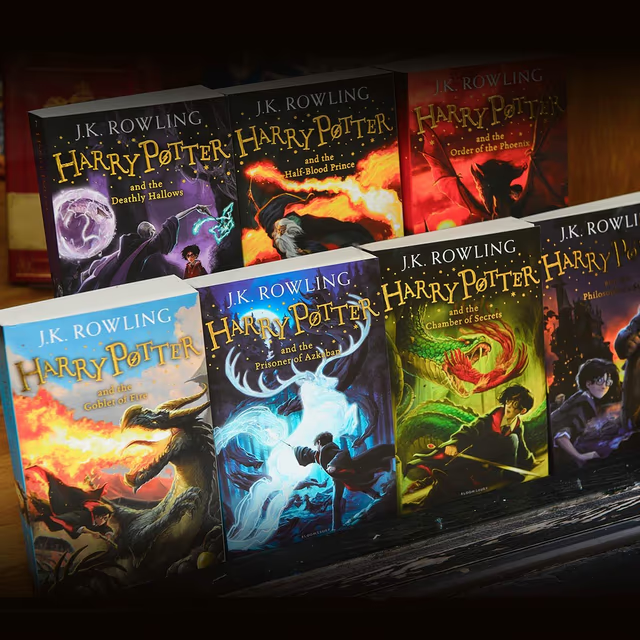
The manuscript for Harry Potter and the Philosopher's Stone was rejected by 12 publishers before a small London press called Bloomsbury agreed to take it on. The first edition had a print run of 500 copies, 300 of which went to libraries. One of those first editions sold at auction in July 2024 for $216,000.
Between that 500-copy print run in 1997 and today, the series has sold over 600 million copies in 85 languages, generating a franchise valued at approximately $32 billion. International Harry Potter Day falls on May 2, the date J.K. Rowling chose for the Battle of Hogwarts, the climactic confrontation in Harry Potter and the Deathly Hallows that ends the Second Wizarding War.
International Harry Potter Day History
The story of Harry Potter begins with a delayed train. In 1990, J.K. Rowling was traveling from Manchester to London when the idea of a boy who did not know he was a wizard arrived, as she later described it, "fully formed." She spent the next five years writing the first novel while working as a teacher, raising a child as a single mother, and living on public assistance.
The completed manuscript was rejected by 12 publishers. Many did not even read the full submission. In 1996, literary agent Christopher Little took on the project, and in 1997, Bloomsbury agreed to publish Harry Potter and the Philosopher's Stone. The initial print run was 500 copies. The editor who championed the book, Barry Cunningham, reportedly told Rowling she should get a day job because writing children's books did not pay well.
From 500 copies to 600 million
The books spread primarily through word of mouth. Children told other children. The series grew with its audience: each successive book became darker, longer, and more complex. Scholastic Press published the US edition on September 1, 1998, under the title Harry Potter and the Sorcerer's Stone, and the American market accelerated the series into a global phenomenon.
By the time the seventh and final novel, Harry Potter and the Deathly Hallows, was published on July 21, 2007, the series had sold hundreds of millions of copies and been translated into 85 languages. The total now exceeds 600 million copies, making it the best-selling book series in history.
The franchise beyond books
Warner Bros. released the first film on November 16, 2001. The eight original Harry Potter films grossed $7.7 billion at the global box office, making the series one of the highest-earning film franchises ever. Including the Fantastic Beasts spin-offs, the total exceeds $9 billion.
The franchise expanded into theme parks, with the Wizarding World of Harry Potter at Universal Studios becoming a major global attraction. The Warner Bros. Studio Tour in Leavesden, UK, has generated over $1 billion in total revenue since opening. The Hogwarts Legacy video game earned over $1 billion for Warner Bros. in 2023. The franchise's total value is estimated at approximately $32 billion.
Meanwhile, those original first editions became some of the most valuable books in modern publishing. A hardback first edition of Philosopher's Stone sold at auction for $216,000 in July 2024.
Controversy and cultural impact
The series also became the most challenged book series of the decade 2000-2009, according to the American Library Association. Critics, primarily from religious groups, alleged the books promoted witchcraft and the occult. The challenges paradoxically increased the books' visibility and readership.
Educators documented what became known as the "Potter Effect": a measurable increase in children's reading engagement attributed to the series. Teachers reported students who had never voluntarily read books becoming avid readers. The series is widely credited with reviving children's interest in long-form reading during the early digital age.
The observance
International Harry Potter Day emerged from the fan community around 2012. The widely cited claim that UK Prime Minister David Cameron officially declared the day originated as an April Fools' Day prank by the fan site MuggleNet on April 1, 2012. The satirical post was shared as fact across holiday calendars and fan wikis, but no official UK government record of such a declaration exists. Fans chose May 2 because it is the date of the Battle of Hogwarts, the climactic confrontation in Deathly Hallows that takes place on May 2, 1998, in the story's timeline.
International Harry Potter Day Timeline
Bloomsbury publishes Harry Potter and the Philosopher's Stone
Scholastic publishes the US edition
First Harry Potter film released
Deathly Hallows published, Battle of Hogwarts revealed
Fan community adopts May 2 as International Harry Potter Day
How to Celebrate International Harry Potter Day
- 1
Reread the series or start it for the first time
The seven books are available through Wizarding World, the official Harry Potter platform. The series rewards rereading: details planted in early books pay off hundreds of pages later.
- 2
Take the Sorting Hat quiz
The official Sorting Hat experience on Wizarding World assigns you to one of the four Hogwarts houses. Over 100 million fans have been sorted since the quiz launched.
- 3
Donate a Harry Potter book to a school or library
The series remains one of the most requested titles in school libraries. Donating a copy introduces a new generation of readers to the books that defined reading for millions of children. Check with your local library or school about their most-needed titles.
- 4
Learn about banned books and intellectual freedom
The American Library Association's most challenged books list documents efforts to remove books from libraries and schools. Harry Potter's history on this list raises important questions about who decides what is appropriate to read.
- 5
Visit a Harry Potter filming location or exhibition
The Warner Bros. Studio Tour in Leavesden, UK, preserves original sets, props, and costumes from the films and has generated over $1 billion in revenue. In the US, the Wizarding World of Harry Potter at Universal Studios recreates Hogsmeade and Diagon Alley.
Why We Love International Harry Potter Day
- A
A single rejected manuscript became a $32 billion franchise
The Harry Potter series was rejected by 12 publishers before Bloomsbury printed 500 copies of the first book. It has since sold over 600 million copies in 85 languages, generated $7.7 billion in film revenue, and spawned theme parks, video games, and merchandise worth a combined $32 billion. The story of its creation is itself a lesson in persistence.
- B
The series measurably changed how children read
The 'Potter Effect' describes the increase in childhood reading engagement attributed to the series. Teachers reported non-reading children becoming avid readers. The books grew longer and more complex with each installment, training young readers to handle increasingly sophisticated narratives during a period when attention spans were shrinking.
- C
It became the most challenged book series of a decade
The American Library Association ranked Harry Potter as the most challenged book series from 2000 to 2009, primarily due to religious objections alleging the books promoted witchcraft. The challenges raised fundamental questions about intellectual freedom, the role of libraries, and who gets to decide what children read.
Holiday Dates
| Year | Date | Day |
|---|---|---|
| 2023 | Tuesday | |
| 2024 | Thursday | |
| 2025 | Friday | |
| 2026 | Saturday | |
| 2027 | Sunday |