Holiday Calendar

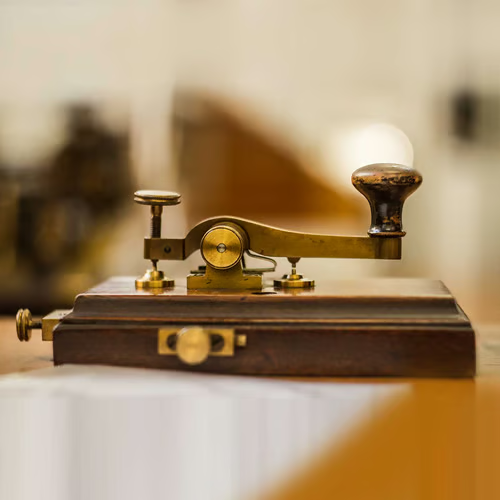
Morse Code Day

Next celebratedTuesday, April 27, 2027

Morse code was still gaining letters in the 2000s: between 1998 and 2004 the ITU added the at sign, the one in the middle of an email address. April 27 marks a code that is not quite the one Morse's own line ran.

Countdown to the day
--DAYS
--HRS
--MIN
--SEC
Have an update or spot an error?
YEARLY DATEApril 27
OBSERVED INInternationally
CATEGORYTech
SUBCATEGORYSoftware
ORIGIN

Community Origin

FOUNDING ENTITY
Not documented
FIRST OBSERVED
Not documented
The Library of Congress dates Samuel Morse's birth to April 27, 1791. The day named for his code carries no such record.
HOW THE HOLIDAY CAME TO BE

A birthday on record, an observance without one.

No founder, inception year or establishing document for Morse Code Day could be located. What the record does supply is the reason for the date: the Library of Congress dates Samuel Finley Breese Morse's birth to April 27, 1791, in Charlestown, Massachusetts.

+ Know the story? Submit a founder Help us complete this holiday
INTRO

The at sign arrives in a telegraph alphabet

In March 1998 the International Telecommunication Union published the rules for sending a telegram by Morse, and its list of characters stopped at the multiplication sign. By May 2004 the same body's Morse text carried one more entry at the bottom of the list: the commercial at sign, the symbol in the middle of an email address. Morse Code Day is a day for a code that was still gaining characters in the 2000s.

That is easy to miss, because the code is usually filed under history. The union's 2009 recommendation on international Morse code sets out the characters and the exact timing an operator has to keep. It also records where use continues: the amateur and amateur-satellite services, and, in the union's own words, to a diminishing extent in the mobile and fixed services.

The other thing the standard shows, read beside Alfred Vail's 1845 account of the working line, is that it is not quite the code Samuel Morse's own line ran. The gap between two words was six dots on the line that ran from Washington to Baltimore. In the international standard it is seven.

Advertisement

GOOD TO KNOW

Surprising facts about Morse Code Day

The rules never spelled out the letters

Article XVI of the 1906 Berlin service regulations prints the ship distress signal as dots and dashes, and so does the US Radio Act of 1912. The IMO says the familiar letters are not an abbreviation and have no special significance beyond being easy to remember and send.

The ITU says the first networks were in England

The ITU's own history records that the first networks were installed in England by William Fothergill Cooke and Charles Wheatstone, and that Samuel Morse opened a network in the United States in 1844.

Silence was part of the old alphabet

Leonard Gale, testifying under oath in Morse v. O'Reilly in August 1848, described the alphabet of Morse as consisting of horizontal dashes, dots and spaces. He listed the pause alongside the marks, as one of the three things the alphabet was made of.

More than 3,800 comments reached the FCC

Before the Commission removed the five words per minute telegraphy examination in 2007, its own order records, over 3,800 comments arrived on the proposed rule changes.

A society formed the day the keys went quiet

The Maritime Radio Historical Society says it was formed on 12 July 1999, which it calls the date of the supposed last commercial Morse transmission in the US. Its founders went to the KPH sites expecting vandalism and found an intact radio time capsule, the receivers still on, keeping watch on the Morse calling channels.

ORIGINS

Morse Code Day history

INTRODUCTION

The moment the code became an alphabet has a month attached to it. In January 1838 the telegraph stopped sending numbers looked up in a word dictionary and began sending a pattern for each letter. Who worked that out is contested.

CHAPTER 01

Whose alphabet was it

Alfred Vail and Samuel Morse left records pointing in opposite directions. Vail's own book of 1845 says the alphabet "was originated on board the packet Sully, by Prof. Morse", while Morse's report on the Paris Exhibition listed "the dot and line alphabet" among his own inventions. Vail's son published his father's letters in 1914 to argue the other way.

The disagreement did not end with them. The Library of Congress credits Morse with the change, from a telegraphic dictionary to a code for each letter. The Smithsonian Institution Archives, which holds Vail's papers, credits Vail with a simpler alphabetic system to replace Morse's numerical one, and notes that Morse's name went on the patents.

CHAPTER 02

Two codes, one name

Vail's book also describes the code the Washington to Baltimore line actually ran, and it is not the code the ITU's recommendation sets out. A touch about four dots long was the mark for L, and one about six dots long the mark for zero. The recommendation gives the dash a single length, three dots, and spells both letters out of dots and dashes.

Encyclopaedia Britannica records that the original American code is hardly in use today, though the American telegraph industry kept it until teleprinters took over. The two versions still agree on one thing: three dots separate letters in both, and the international code is a revision of the American one rather than a rival to it.

CHAPTER 03

The day itself

Morse Code Day has nothing like that paper trail. No founder, year or establishing document turns up for it, and the earliest archived page about it that turned up dates from 2012. What is documented is the date: the Library of Congress records Samuel Finley Breese Morse's birth in Charlestown, Massachusetts, on April 27, 1791.

The Library's record of the man covers more than wires: it lists his 1835 book Foreign Conspiracy Against the Liberties of the United States, described there as a treatise against the political influence of Catholicism. He ran for mayor of New York the next spring for a nativist party, taking 1,496 votes.

TIMELINE

Timeline

A code for each letter

In January the telegraph switches from a numbered dictionary of words to a code for each letter, removing the need to encode and decode every word.

What hath God wrought

On 24 May the message travels from the Supreme Court chamber in the Capitol to the railroad depot in Baltimore.

Morse code written into treaty

Twenty countries sign the first International Telegraph Convention in Paris, and its service regulations require the adoption of Morse code and its instruments.

Ships get one distress signal

The Berlin radiotelegraph convention tells ships in distress to send three dots, three dashes and three dots, repeated at brief intervals.

Morse leaves the shipping lanes

On 1 February the Global Maritime Distress and Safety System becomes fully operational and Morse code is phased out at sea.

America drops the code test

On 23 February the removal of the five words per minute telegraphy examination for two US amateur licence classes takes effect.
Morse will carry on in other parts of the world even after the keys in North America are finally silent.
Richard DillmanMaritime Radio Historical Society, present at the 1999 sign-off

WHY THIS DAY MATTERS

Why Morse Code Day Matters

SAFETY

One agreed pattern, and the traffic stopped for it

From the Berlin regulations of 1906 a ship in distress had one agreed pattern to send, and a station that heard it had to stop its own traffic and, unless the call named another station, answer. That same pattern was still the distress signal at sea until the Global Maritime Distress and Safety System became fully operational in 1999.

SKILL

Working the code was a full trade

The IMO's account of the old maritime radio system lists specialization among its limits: Morse telegraphy required many years of training and practice. If something happened to the radio operator, it was unlikely that anyone else on board would be able to use the telegraphy equipment.

KEEPING

Whoever keeps the day decides what it is

Because the day is kept by whoever chooses to keep it, what happens on it comes from individual institutions rather than a central campaign. The Museum of Maritime Navigation and Communication in Staten Island posted that it marked National Morse Code Day on April 27 in 2020, in the middle of the COVID-19 crisis, with an online Morse game.

GET INVOLVED

How to Observe Morse Code Day

EDITOR'S PICK

Learn the timing, not just the letters

Most charts give the dots and dashes and stop there, though the standard fixes the silences as well. Set your spacing from the ITU's own recommendation on international Morse code rather than by feel.

SEND

Send your own name in dots and dashes

Work it out by hand from the character table rather than a translator, keeping the gaps to the lengths the standard sets. The gaps are specified as precisely as the marks are.

LISTEN

Listen for a station that still keys Morse

The Maritime Radio Historical Society operates the former coast stations KPH and KFS at Bolinas and Point Reyes. Its Night of Nights transmission runs every 12 July, opening at 5:01pm Pacific time.

READ

Read the 1906 distress rule in the original

The ITU's library has scanned the Berlin convention of 1906, service regulations included. Article XVI is where the signal itself is set out.

Test your knowledge

How well do you know Morse Code Day?

1 / 7

Why does Morse Code Day fall on April 27?

Answer

No. It is an unofficial observance with no legal standing found, so it is a normal working day. A search of the Federal Register's full-text index, which runs from 1994, returns nothing for either Morse Code Day or National Morse Code Day.

COLOPHON

Sources

How we know what’s on this page. References, not endorsements.

20sources
15primary records
11independently dated
Primary records
Library of Congress
Samuel F. B. Morse Papers: Timeline, 1791 to 1839
Dated entries for Morse's birth, his nativist mayoral run and the 1838 letter code.
View source
Library of Congress
Samuel F. B. Morse Papers: Timeline, 1840 to 1872
The 1844 Washington to Baltimore message and the 1865 founding of the International Telegraph Union.
View source
International Telecommunication UnionOctober 2009
Recommendation ITU-R M.1677-1: International Morse code
The international character set, element lengths and rules for working Morse.
View source
International Telecommunication UnionMay 2004
Recommendation ITU-R M.1677: International Morse code, first edition
The 2004 character list, the first ITU Morse text to carry the commercial at sign.
View source
International Telecommunication UnionMarch 1998
Recommendation ITU-T F.1: Operational provisions for the international public telegram service
The withdrawn Morse provisions, whose character list stops at the multiplication sign.
View source
International Telecommunication Union
ITU is Born in Paris: the 1865 International Telegraph Conference
The Paris convention of 1865 and the regulation requiring Morse code and its instruments.
View source
International Telecommunication Union
Pre-1865 International Telegraph Agreements
The earliest cross-border telegraph treaties and the first networks built in England.
View source
ITU Library and Archives1912
International Radio Telegraph Convention of Berlin: 1906
The signed 1906 convention with the service regulations carrying the ship distress signal.
View source
International Maritime Organization1999
GMDSS and SAR 1999
The 1999 phase-out of Morse at sea, and why the distress letters abbreviate nothing.
View source
Federal Register24 January 2007
Amateur Service Rules, FCC Report and Order, 72 FR 3081
The order removing the five words per minute telegraphy examination for two licence classes.
View source
Alfred Vail1845
The American Electro Magnetic Telegraph, with the Reports of Congress
The 1845 code in its own words, mark lengths and spacing included.
View source
J. Cummings Vail1914
Early History of the Electro-Magnetic Telegraph, from Letters and Journals of Alfred Vail
The family's case for Vail, with sworn testimony from Morse v. O'Reilly.
View source
Maritime Radio Historical Society
The End of Morse
An eyewitness account of the 1999 sign-off at the Half Moon Bay station.
View source
Maritime Radio Historical Society
Maritime Radio Historical Society: Night of Nights
The society's founding date and its annual Morse transmission from KPH.
View source
International Amateur Radio Union
World Amateur Radio Day
The April 18 observance and the union's founding in Paris in 1925.
View source
Additional coverage
FOR MARKETERS & CREATORS

Turn every day into a moment your audience actually shows up for.

8.4M
Monthly readers
5K+
Holidays tracked