Holiday Calendar

National Spaghetti Day

Next celebratedMonday, January 4, 2027

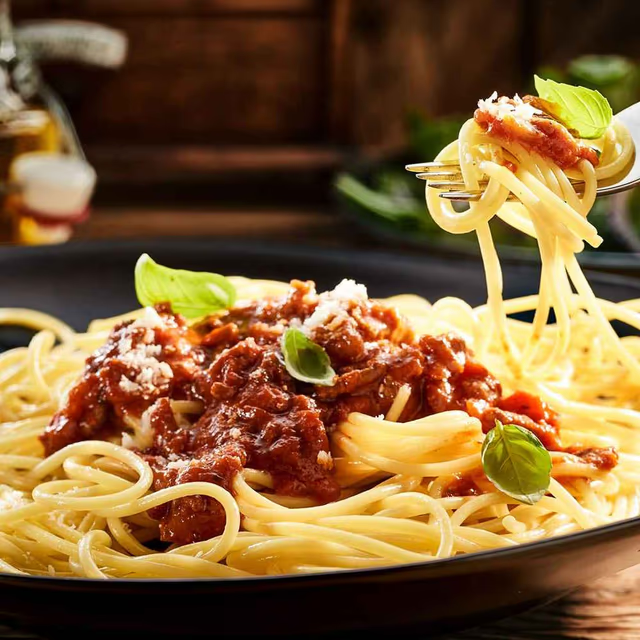
Almost every kitchen has a box of spaghetti in it somewhere, and National Spaghetti Day is the nudge to do something good with it. Make the sauce from scratch this time, and let it cook longer than you usually would.

Countdown to the day
--DAYS
--HRS
--MIN
--SEC
Have an update or spot an error?
YEARLY DATEJanuary 4
OBSERVED INUnited States
CATEGORYFood
SUBCATEGORYPasta
ORIGIN

Community Origin

FOUNDING ENTITY
Not documented
FIRST OBSERVED
Not documented
HOW THE HOLIDAY CAME TO BE

The oldest surviving trace is a web capture.

No founder, proclamation, or establishing record for National Spaghetti Day was located in the Federal Register, in HathiTrust's index of Chase's Calendar of Events, or in two searchable American newspaper archives. The earliest trace found is a holiday listing for a January 4 spaghetti day, captured by the Internet Archive in November 2013, which dates the listing rather than the day.

+ Know the story? Submit a founder Help us complete this holiday
INTRO

Where macaroni stops and spaghetti begins

The United States government defines spaghetti with a ruler. Federal labelling rules put it in one class of food with macaroni and vermicelli, then set it apart as the strand measuring more than 0.06 inch and not more than 0.11 inch in diameter. National Spaghetti Day belongs to everything inside that band.

Below the band the same dough is vermicelli. Above it, a tube of the same dough is macaroni. Three names for one food, and a ruler doing most of the sorting.

That is a lot of precision for a weeknight dinner, and it points at what spaghetti really is. Behind the strand sits an industrial product with a long paper trail, running from a screw press in Naples to a trade order still on the books in Washington.

Advertisement

DEALS & OFFERS

2026’s deals have wrapped

See who celebrated this year, and browse offers from past years.

ORIGINS

Spaghetti Day history

INTRODUCTION

A box of spaghetti is a manufacturing story before it is a cooking one. Gragnano, in the Province of Naples, has been known for producing hard-wheat pasta since the 16th century.

Two problems had to be solved before any of it could travel. The dough had to be pushed into a shape, and the shape had to be dried. Gragnano answered the second one with its streets.

CHAPTER 01

The town that was planned for the wind

In the mid 19th century the town drew up a new plan. The width of the streets and the height of the buildings were set so that wind could circulate better and help the pasta dry.

The first problem was answered with bronze. Pasta production there has always used bronze draw-plates, and the variety of plates is what allowed the variety of shapes.

CHAPTER 02

Jefferson copies a Neapolitan press

Around 1787 Thomas Jefferson wrote out how the Neapolitans did it. "The best maccaroni in Italy is made with a particular sort of flour called Semola, in Naples," he noted, before describing dough forced by a screw through a perforated iron box.

He also caught the detail that matters most. There is, he wrote, "a set of plates which may be changed at will, with holes of different shapes and sizes for the different sorts of Maccaroni."

The machine followed him home. In February 1789 William Short wrote to say he had procured a mould for making maccaroni in Naples on his behalf, and by 1809 Jefferson was buying pasta from Sartori's works in Trenton, New Jersey, at sixteen cents the pound.

CHAPTER 03

Which Italy arrived in America

About 4 million Italians emigrated to the United States between 1880 and 1920, roughly 85 percent of them from the south. So the cooking that made its mark here came from Sicily, Calabria, Campania, Abruzzi and Molise, and not from Venice.

The day at the end of that line is the thinnest part of the record. Four searches for its name came back empty: the Federal Register, the digitized run of Chase's Calendar of Events, and two American newspaper archives. Everything older belongs to the pasta rather than to the day.

TIMELINE

Timeline

Jefferson draws a macaroni press

His drawing of the machine, with a sectional view of the holes the dough is pushed through, survives in the Library of Congress.

A mould arrives from Naples

William Short wrote to Jefferson that he had procured a mould for making maccaroni in Naples at his request and forwarded it to Paris.

American macaroni, sixteen cents a pound

Jefferson had been supplied from Sartori's works at Trenton, New Jersey, a maker he said made them well.

Italian emigration reshapes American cooking

About 4 million Italians emigrated to the United States between 1880 and 1920, roughly 85 percent of them from the south.

Italy's regional cooking, gathered in one book

Pellegrino Artusi published La scienza in cucina e l'arte di mangiar bene, the first to bring the regional cuisines together and the first written for the home cook.

The day's oldest surviving trace

The Internet Archive captured a holiday listing for a January 4 spaghetti day in November of that year.

WHY THIS DAY MATTERS

Why We Love National Spaghetti Day

HEALTH

Folic acid entered the enriched pasta standard by rule in 1996.

American rules set what has to be in a box labelled enriched spaghetti: stated amounts of thiamin, riboflavin, niacin, folic acid and iron in each pound. The folic acid clause was written into that standard by an FDA rule in 1996, effective on 1 January 1998, to help women of childbearing age reduce the risk of a pregnancy affected by spina bifida or other neural tube defects.

TRADE

Italian pasta crosses the border under an order

Since 24 July 1996, non-egg dry Italian pasta in packages of five pounds or less has entered the United States under a Commerce Department antidumping order, issued after the International Trade Commission found the American pasta industry materially injured. Commerce continued the orders again in 2024, after a fifth sunset review.

PLACE

One town's pasta name is protected by law

Pasta di Gragnano has sat on the European Union register of protected geographical indications since Commission Implementing Regulation (EU) No 969/2013. The name only goes on pasta whose mixing, kneading, extrusion, drying, cooling and stabilisation all happen inside the Municipality of Gragnano.

GOOD TO KNOW

Surprising facts about National Spaghetti Day

The other spaghetto means a fright

Treccani's dictionary carries two separate headwords from two different roots. One is the pasta, a diminutive of spago, string, named for its shape; the other is glossed as a reaction to something frightening.

Spaghetti western is not an Italian phrase

Treccani files spaghetti western and spaghetti house as Anglophone coinages, and glosses the first back into Italian as western all'italiana.

Dry spaghetti almost never breaks in two

Richard Feynman noticed that a strand bent by bringing its ends together appears almost always to break into at least three pieces. A team filming at up to 1,000,000 frames per second showed in 2018 that twisting it hard enough first forces a clean break in two.

Protected pasta is packed against a clock

The Pasta di Gragnano specification caps moisture in the finished pasta at 12,5 percent and requires packaging within 24 hours of production, because moisture loss changes it and leaves the shapes liable to break in transit.

MYTH VS FACT

Common Misconceptions

The myth

Thomas Jefferson introduced pasta to America.

The truth

Monticello states plainly that he was not the first to bring macaroni to America and did not invent the macaroni and cheese recipe often credited to him.

The myth

Spaghetti and meatballs is a traditional Italian dish.

The truth

Go to Italy and you will not find a dish by that name. Italian polpette are eaten on their own or in soup, and are often no bigger than golf balls.

GET INVOLVED

How to Celebrate National Spaghetti Day

EDITOR'S PICK

Cook a pot and taste it early

Pull a strand out before the box says you should and bite it. The Gragnano specification lists the cooked consistency it wants as firm yet elastic, which is a question of timing more than technique.

BUY

Buy a bronze drawn box and compare

Pasta strained through bronze draw-plates comes out with a furrowed surface that holds sauce. Put it beside whatever you usually buy and dress both with the same thing.

CHECK

Check what the box actually says

In American stores spaghetti, vermicelli and macaroni are labelling terms, not three different recipes. Look along the shelf and work out which one you have been buying all along.

SERVE

Serve one big bowl for the table

One pot feeds a crowd without much fuss. Dress it in the pot rather than on the plates, and put the bowl in the middle of the table.

Test your knowledge

How well do you know National Spaghetti Day?

1 / 8

Under US food-labelling rules, what separates spaghetti from vermicelli?

Answer

No. It is an unofficial observance, so January 4 is a normal working day, and the Federal Register carries no document naming it.

COLOPHON

Sources

How we know what’s on this page. References, not endorsements.

14sources
13primary records
6independently dated
Primary records
Office of the Federal Register
21 CFR 139.110, Macaroni products
The US standard that separates macaroni, spaghetti and vermicelli by diameter.
View source
Office of the Federal Register
21 CFR 139.115, Enriched macaroni products
The vitamins and iron a pound of enriched spaghetti must contain.
View source
US Food and Drug Administration1996-03
Food Standards: Amendment of Standards of Identity For Enriched Grain Products to Require Addition of Folic Acid
The 1996 rule that added folic acid to enriched pasta, effective January 1998.
View source
US Department of Commerce1996-07
Notice of Antidumping Duty Order and Amended Final Determination: Certain Pasta From Italy
The order that put duties on Italian dry pasta in retail-sized packages.
View source
US Department of Commerce2024-09
Certain Pasta From Italy and the Republic of Turkiye: Continuation of Antidumping Duty Orders and Countervailing Duty Orders
Commerce keeps the pasta orders in force after a fifth sunset review.
View source
Library of Congress
Thomas Jefferson's drawing of a macaroni machine and instructions for making pasta, ca. 1787
Jefferson's own sketch of the press, showing the holes the dough is pushed through.
View source
Thomas Jefferson Foundation, Monticello
Macaroni, Thomas Jefferson Encyclopedia
His transcribed notes on Neapolitan pasta making, his Naples mould and his Trenton supplier.
View source
Official Journal of the European Union2013-03
Publication of an application: PASTA DI GRAGNANO
The full product specification, from bronze draw-plates to the town's wind-planned streets.
View source
European Commission2013-10
Commission Implementing Regulation (EU) No 969/2013
The regulation entering Pasta di Gragnano in the EU register of protected names.
View source
Proceedings of the National Academy of Sciences2018-08
Controlling fracture cascades through twisting and quenching
High-speed footage of spaghetti breaking, and the twist that makes it break in two.
View source
Istituto della Enciclopedia Italiana
spaghetto, Vocabolario on line, Treccani
The Italian dictionary entry: a diminutive of spago, plus the unrelated word for a fright.
View source
International Pasta Organisation
World Pasta Day
The organisers on the 1995 Rome congress and the October 25 date they kept.
View source
HathiTrust Digital Library
Full-text search of Chase's Calendar of Events for 'national spaghetti day'
No hits across the digitized run of the calendar that lists American observances.
View source
Additional coverage
FOR MARKETERS & CREATORS

Turn every day into a moment your audience actually shows up for.

8.4M
Monthly readers
5K+
Holidays tracked