July 9
Fashion Day
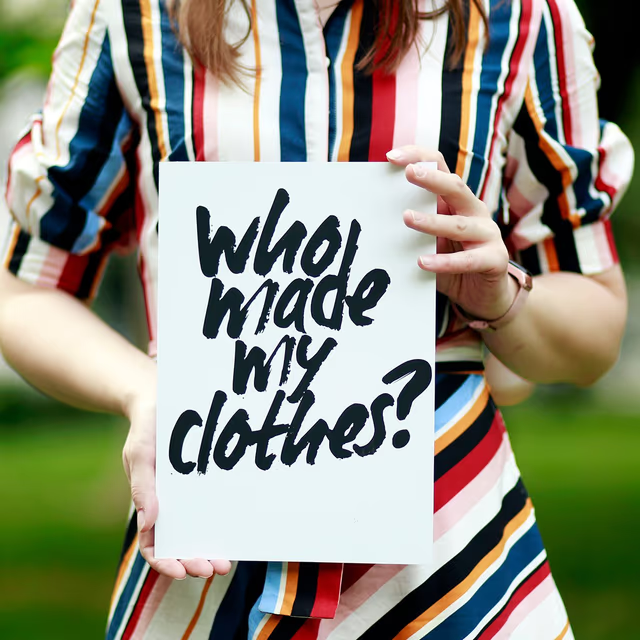
A U.S. observance on July 9 celebrating personal style and the fashion industry, from haute couture to everyday clothing choices.
Unknown
Community Origin
No verified creator has been identified for Fashion Day. The observance appears to have emerged on social media in 2016 as a grassroots celebration of personal style and individual expression through clothing.
Introduction
The global fashion industry generates approximately $1.7 trillion in annual revenue and employs more than 75 million people worldwide. Fashion Day sits at the intersection of that economic engine and the personal choices that drive it, marking a day to consider how clothing functions as both self-expression and one of the world's largest industries.
The observance has no documented founder, having emerged on social media in 2016 as a grassroots celebration of personal style. But the history behind what people wear, and why, stretches back centuries. From Charles Frederick Worth's invention of haute couture in 1858 to the ready-to-wear revolution that made designer aesthetics accessible to the general public, fashion has continuously blurred the line between art and commerce.
Fashion Day History
Before the mid-19th century, clothing was made to measure. Tailors and dressmakers crafted garments individually for clients, and the concept of a "designer" who set trends did not exist. Fashion was a local transaction between a customer and a craftsperson, with styles spreading slowly through illustrations, trade, and courtly influence.
The invention of haute couture
Charles Frederick Worth changed that model in 1858 when he opened a fashion house in Paris that operated on a new principle: the designer, not the client, determined what was made. Worth created seasonal collections, presented them on live models, and sold garments under his own label. The approach transformed fashion from a service into an art form with a named creator. In 1868, the industry formalized itself with the founding of Le Chambre Syndicale de la Haute Couture, which set strict criteria for what could be called couture: handmade construction, private fittings, minimum staff requirements, and biannual collection presentations.
Ready-to-wear democratizes clothing
While couture served the wealthy, the ready-to-wear industry was quietly transforming how most people dressed. Mass production of standardized sizes, which began with military uniforms in the early 19th century, spread to civilian clothing. By 1890, 60% of garments produced in the United States were ready-made. By 1951, that figure reached 90%.
The pivotal moment connecting couture and ready-to-wear came in 1966, when Yves Saint Laurent opened Saint Laurent Rive Gauche. It was the first freestanding boutique from a couture house offering high-end ready-to-wear, bringing designer aesthetics to customers who could not afford or access custom garments. The model proved so successful that nearly every major fashion house followed.
Fast fashion and its backlash
In the 1990s, retailers like Zara compressed the design-to-store cycle from months to weeks, creating a model built on speed, low prices, and constant novelty. The industry now produces over 100 billion garments annually. The environmental and labor costs of that volume have driven a counter-movement: the secondhand apparel market reached $260 billion in 2025, and sustainable fashion has moved from a niche concern to a mainstream consumer expectation.
Fashion Day Timeline
Charles Frederick Worth opens the first couture house
Chambre Syndicale regulates French fashion
Dior introduces the New Look
YSL launches ready-to-wear retail
Fast fashion reshapes the industry
Fashion Day emerges on social media
How to Celebrate Fashion Day
- 1
Explore the Met's Costume Institute collection
The Metropolitan Museum's Costume Institute houses over 33,000 costumes and accessories spanning five centuries. Their online collection lets you examine garments from Worth's couture era through contemporary design.
- 2
Audit and reimagine your wardrobe
Pull out everything you own, identify what you actually wear, and donate what you do not. Fashion stylists call this a 'closet edit,' and it often reveals personal style patterns that are invisible when clothes are crammed together on hangers.
- 3
Shop secondhand or vintage
Platforms like thredUP offer curated secondhand clothing that reduces environmental impact while providing access to brands and styles at lower price points.
- 4
Learn about sustainable fashion certifications
The Global Organic Textile Standard (GOTS) certifies textiles made from organic fibers with strict environmental and social criteria. Understanding certification labels helps consumers make informed choices about the clothing they buy.
- 5
Document your personal style evolution
Take a photo of your outfit every day for a week and review the patterns at the end. The exercise reveals unconscious style choices and helps clarify what you want your clothing to communicate.
Why We Love Fashion Day
- A
Fashion is one of the world's largest industries
The global fashion industry generates approximately $1.7 trillion in annual revenue and employs more than 75 million people. If measured as a standalone economy, it would rank as the seventh largest in the world, larger than the GDP of most individual countries.
- B
The secondhand market is reshaping consumption
The global secondhand apparel market was valued at $260 billion in 2025 and is projected to reach $522 billion by 2030. The growth reflects a shift in consumer values toward sustainability, affordability, and reducing the environmental impact of clothing production.
- C
Clothing communicates identity before words do
Psychological research consistently shows that clothing choices affect how people are perceived and how they perceive themselves. The concept of 'enclothed cognition,' introduced by researchers Adam and Galinsky in 2012, demonstrated that the symbolic meaning of clothes can influence the wearer's cognitive processes and behavior.
Holiday Dates
| Year | Date | Day |
|---|---|---|
| 2023 | Sunday | |
| 2024 | Tuesday | |
| 2025 | Wednesday | |
| 2026 | Thursday | |
| 2027 | Friday |