April 6
National Acai Bowl Day
An annual observance on April 6 celebrating acai bowls, a blended dish of frozen acai berry pulp topped with fruits, granola, and other toppings, originating from Brazilian Amazonian cuisine.
Sambazon
Corporate Initiative
Sambazon, a company founded in 2000 to sustainably harvest and distribute acai from the Brazilian Amazon, established National Acai Bowl Day on April 6, 2013, to promote awareness of acai bowls and the fruit's nutritional profile.
Introduction
National Acai Bowl Day celebrates a food that traveled from the floor of the Amazon rainforest to the top of American wellness menus in less than two decades. The acai berry has been a staple of indigenous Amazonian diets for thousands of years, consumed as a thick, energy-dense porridge mixed with cassava flour. What changed was not the fruit itself but the supply chain: the development of flash-freezing technology solved the berry's critical flaw, a shelf life of only 24 to 48 hours after harvest.
That technological fix opened a market that reached $1.49 billion globally in 2024. The fruit that once could not survive a truck ride out of the Amazon now appears in smoothie shops from São Paulo to Santa Monica, and the bowl format that Brazilian surfers and jiu-jitsu fighters ate for recovery has become one of the fastest-growing categories in American food service.
National Acai Bowl Day Deals
Save $5 on Acai Bowls
Existing and new loyalty members can save $5 on any acai bowl at Playa Bowls.
Learn More
Get BOGO Acai Bowls
Buy one acai bowl in-store to get another for free.
Learn More
Get BOGO Acai Bowl
Loyalty customers can take a friend to one of the participating locations to get buy one, get one free açaí bowls deal.
Learn More
National Acai Bowl Day History
The acai palm (Euterpe oleracea) grows throughout the floodplains of the Amazon River basin, producing clusters of small, dark purple berries that ripen twice annually. Indigenous Amazonian communities have harvested the fruit for thousands of years, eating it as a thick, calorie-dense porridge called açaí na tigela, often mixed with cassava flour or tapioca. For these communities, acai was not a superfood or a trend. It was simply food: a reliable source of energy in a region where caloric density mattered.
The berry remained virtually unknown outside the Amazon until the 1970s and 1980s, when two forces brought it to Brazil's coastal cities. Surfers in Rio de Janeiro discovered it as a cheap, high-energy meal. Simultaneously, the Gracie family, the founders of Brazilian jiu-jitsu, adopted acai bowls as a post-training recovery food and recommended them to their students. The combination of surf culture and martial arts gave acai its first audience beyond the rainforest.
The spoilage problem
Acai berries have a critical limitation: they begin to degrade within 24 to 48 hours of harvest, turning rancid as their high fat content oxidizes. This made commercial distribution essentially impossible for most of the 20th century. The breakthrough came with flash-freezing technology, which allowed processors to pulp and freeze the berries near the harvest site, preserving both nutrition and flavor for months. Frozen pulp now accounts for over 54% of the global acai market.
Sambazon and the American market
In 2000, brothers Ryan and Jeremy Black and Edmund Nichols discovered acai bowls during a surfing trip to Brazil. They founded Sambazon, a company whose name stands for "Sustainable Management of the Brazilian Amazon," to bring the fruit to the United States. Sambazon became the first company to earn USDA organic certification for acai and partnered with Ecocert in 2008 to develop the first Fair Trade certification rules specifically for the acai supply chain. The company works with over 10,000 independent family growers and built a manufacturing plant in Amapá, Brazil.
The holiday and the boom
Sambazon established National Acai Bowl Day on April 6, 2013. By then, acai bowls had already moved from niche surf shops in Hawaii and California to mainstream juice bars and restaurant menus nationwide. The global acai berry market reached $1.49 billion in 2024 and is projected to grow to $2.3 billion by 2033. What began as a subsistence food in the Amazon became one of the defining health food products of the 21st century.
National Acai Bowl Day Timeline
Indigenous Amazonians cultivate acai
Gracie family brings acai bowls to athletes
Sambazon founded
First Fair Trade certification for acai
National Acai Bowl Day established
How to Celebrate National Acai Bowl Day
- 1
Make an acai bowl from scratch
Blend frozen acai pulp packets with a splash of liquid (coconut water, almond milk, or juice) until thick, then top with sliced banana, granola, and honey. The key is keeping the base thick enough to eat with a spoon, not drink through a straw.
- 2
Visit a local acai bowl shop
Find a juice bar or cafe near you that serves acai bowls. Many shops now offer customizable options with dozens of toppings. Compare a basic bowl to a loaded version to understand how toppings change the nutritional profile.
- 3
Learn about sustainable sourcing
Read about Sambazon's sustainability work and how Fair Trade certification works for acai. Understanding where your food comes from changes how you think about a $12 smoothie bowl.
- 4
Try acai in its traditional form
Skip the granola and honey. Blend frozen acai pulp into a thick paste and eat it with cassava flour or tapioca, the way indigenous Amazonian communities have eaten it for generations. The flavor is earthier and less sweet than the Americanized version.
- 5
Compare acai products by nutrition label
Buy two or three different brands of frozen acai and compare their ingredient lists. Some contain added sugar, fillers, or minimal actual acai. Look for products listing acai puree as the first ingredient with no added sweeteners for the most authentic nutritional profile.
Why We Love National Acai Bowl Day
- A
It connects a $1.49 billion industry to indigenous knowledge
The acai bowl trend is built on harvesting practices that indigenous Amazonian communities developed over millennia. National Acai Bowl Day is an opportunity to recognize that the 'superfood' marketed in American smoothie shops originates from a cultural tradition that predates European contact with the Americas.
- B
It demonstrates the impact of fair trade certification
Sambazon's partnership with Ecocert to create Fair Trade certification for acai established a model that now covers over 10,000 independent family growers in the Brazilian Amazon. The certification ensures premium prices, prohibits child labor, and funds community investments in education and healthcare infrastructure.
- C
It highlights a genuinely nutrient-dense food
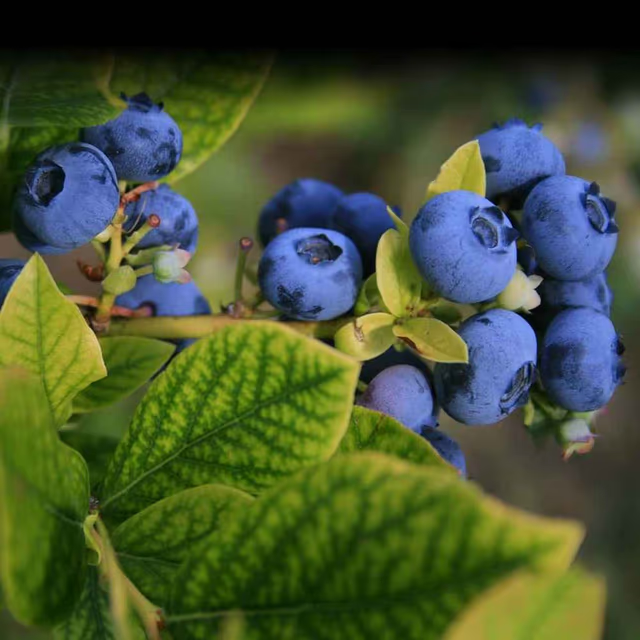
Acai berries contain approximately three times the antioxidant activity of blueberries as measured by ORAC values, along with healthy fats, fiber, and essential minerals. Unlike many foods marketed as superfoods, acai's nutritional claims are backed by peer-reviewed research on anthocyanin content and antioxidant capacity.
Holiday Dates
| Year | Date | Day |
|---|---|---|
| 2023 | Thursday | |
| 2024 | Saturday | |
| 2025 | Sunday | |
| 2026 | Monday | |
| 2027 | Tuesday |