Holiday Calendar

National Homemade Cookies Day

Next celebratedThursday, October 1, 2026

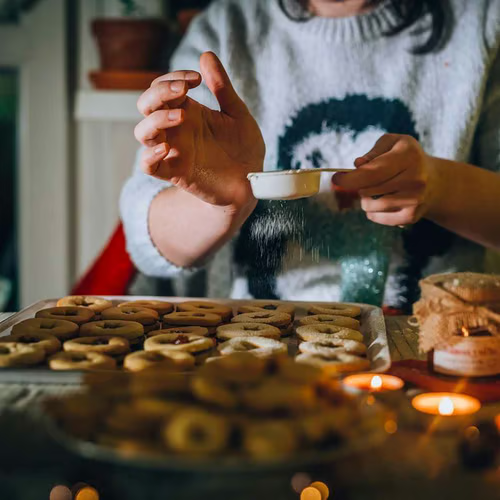
National Homemade Cookies Day marks the cookies that come out of somebody's own kitchen rather than a wrapper. Choose a recipe simple enough to make from memory, and bake enough to hand some over the fence.

Countdown to the day
--DAYS
--HRS
--MIN
--SEC
Have an update or spot an error?
YEARLY DATEOctober 1
OBSERVED INUnited States
CATEGORYFood
SUBCATEGORYDesserts
ORIGIN

Community Origin

FOUNDING ENTITY
Not documented
FIRST OBSERVED
Not documented
HOW THE HOLIDAY CAME TO BE

No founder, and a date nobody explains.

The founding date that circulates online for National Homemade Cookies Day traces to a single blog post, which offered it as a guess about an unrelated commodities exchange. No documented founder or establishment record has been identified, and nothing naming the day appears in the Federal Register.

+ Know the story? Submit a founder Help us complete this holiday
INTRO

Homemade is a legal category before it is a compliment

In Wisconsin, a home baker can sell you a cookie only because a judge said so. A 2017 court ruling struck down the state's ban on selling home-baked goods, finding the licensing requirement was not related to public health and safety.

Fudge from that same kitchen is still barred. The state's Court of Appeals upheld that line in November 2024, and in April 2025 the Wisconsin Supreme Court declined to review it.

So homemade is not only a description of how something was made. It is a category with edges, and the states draw them differently.

Advertisement
ORIGINS

Homemade Cookies Day history

INTRODUCTION

In 1923 a group of American millers who made self-rising flour had a problem. The public had grown uneasy about chemical additives in flour.

Their answer was to promote what the flour was for. The group surveyed wholesalers, retailers and shoppers, designed a seal of quality for packages, and pushed out advertising and recipe leaflets.

CHAPTER 01

The trade group that sold baking at home

It kept renaming itself as it grew. It incorporated in 1951 as the Self-Rising Flour Institute.

Self-rising cornmeal was winning its own share of home kitchens, and on 15 December 1959 the two merged. The programme later left Nashville for the Millers' National Federation, which shared its overhead costs. It ran across 17 southeastern states until 1977.

CHAPTER 02

When the flour stopped going home

The millers kept a record of the shift as it happened. At the start of the twentieth century, by their own account, little more than ten percent of American flour went to bakeshops. That share had doubled by the end of the First World War.

By the end of the Second World War, nearly sixty percent was going to bakeries. The association that grew out of those millers dates the real collapse later, writing that a significant nationwide decline in home baking began in the 1960s. It attributes that to women entering the workforce, changed family meals, microwave ovens and fast food.

CHAPTER 03

Homemade becomes a term of law

As home baking shrank at the till, selling it turned into a legal question. New Jersey barred the sale of food made at home outright until its cottage food rules took effect on 4 October 2021.

Rhode Island, which had let only farmers sell food made at home, opened the same door to everyone else the following year. Selling what you baked in your own kitchen became lawful across the country only in the 2020s.

National Homemade Cookies Day sits on top of that history without explaining itself: no founder has been identified, and the mid-1920s date attached to it online traces to a single 2010 blog post that offered the idea as a guess. Baking at home and handing the result to somebody else is a practice trade groups promoted for a century, legislatures argued over, and one court had to protect.

TIMELINE

Timeline

Millers organize to push home baking

Self-rising flour millers set up a programme to answer a public scare about chemical additives and to promote baking at home.

Flour and cornmeal programmes merge

On 15 December the self-rising flour and cornmeal interests combined into a single promotion body.

Millers record where the flour goes

About seventy five percent of domestic flour went to bakers and other secondary processors, with the rest used in home kitchens.

Regional promotion programme ends

The 17-state southeastern campaign for self-rising flour and cornmeal stopped running.

Wisconsin court strikes a baking ban

A Lafayette County judge held that the state's ban on selling home-baked goods was unconstitutional.

New Jersey legalizes home food sales

Cottage food rules took effect on 4 October, ending an outright ban on selling food made in a home kitchen.

BY THE NUMBERS

National Homemade Cookies Day by the Numbers

4%
US flour sold to home bakers
$50,000
New Jersey cottage food sales cap
$100
New Jersey home baker permit fee
745
Comments on New Jersey's rule
25
States capping home food sales, 2022
Selling foods like fudge and roasted coffee beans would have helped our members support their families, and now they've lost those opportunities.
Jobea MurrayBoard president, Wisconsin Cottage Food Association

WHY THIS DAY MATTERS

Why We Love National Homemade Cookies Day

TRUST

The label must say the health department never inspected the kitchen.

New Jersey requires every cottage food package to carry the line, "This food is prepared pursuant to N.J.A.C. 8:24-11 in a home kitchen that has not been inspected by the Department of Health." The state's answer to the trust problem is to make the baker say it out loud.

PATCHWORK

What counts as homemade depends on the state

A 2022 Institute for Justice survey found 19 states where a regulator's approved list decides which foods a home kitchen may sell at all. Fifteen more barred those bakers from putting an order in the mail.

LEGISLATURE

The cookie bill keeps coming back

Wisconsin lawmakers have argued over home baking for more than a decade, in legislation local reporting calls the cookie bill. The version before them in 2026 would cap a home kitchen's gross sales at $40,000.

GET INVOLVED

How to Celebrate National Homemade Cookies Day

EDITOR'S PICK

Bake a batch from scratch

Pick a recipe and make it start to finish in your own kitchen, mixes left in the cupboard. The point of the day is the part a factory cannot do for you.

LOOK

Look up your state's cottage food rules

Most states run a programme setting what a person may bake at home and sell. Yours will tell you where the line falls and what a permit costs.

BUY

Buy from a licensed home baker

New Jersey's rules, for instance, let a home baker sell at farmers markets and farm stands. Ask the person behind the table what they are permitted to make.

TEACH

Teach somebody their first batch

Home baking is a skill that moves between people rather than through a supply chain. Hand a child or a housemate the bowl and talk them through it.

GIVE

Give a tin away without an occasion

Box up what you baked and take it to a neighbour, a colleague or a friend who is not expecting anything. Handing it over in person is most of the gesture.

Test your knowledge

How well do you know National Homemade Cookies Day?

1 / 8

What does New Jersey require on the label of food baked at home for sale?

Answer

No. It is an unofficial observance, and nothing naming the day appears in the Federal Register, so schools, offices and banks all keep normal hours.

COLOPHON

Sources

How we know what’s on this page. References, not endorsements.

11sources
7primary records
5independently dated
Primary records
New Jersey Department of Health
Cottage Food Operator Rules (N.J.A.C. 8:24-11)
The operative New Jersey rule for selling food made in a home kitchen, setting the $50,000 gross sales cap, the $100 two-year permit, the residence-only production limit, and the exact disclosure sentence every label must carry.
View source
New Jersey Register2021-10-04
Cottage Food Operator Permit, adopted new rules N.J.A.C. 8:24-11, 53 N.J.R. 10(1)
The rulemaking notice that legalized home food sales in New Jersey, recording the April 2020 proposal, the July 2021 adoption by the Commissioner of Health, the 4 October 2021 effective date, and comments from 745 people.
View source
Wisconsin State Legislature
2017 Senate Bill 271, relating to the sale of homemade baked goods and homemade canned goods
The legislature's own record for one session of Wisconsin's recurring home-baking bill, showing its subject clause, a committee recommendation of passage in June 2017, and the Assembly failing to concur in March 2018.
View source
Home Baking Association
HBA History
The association's own account of its founding in 1923 by self-rising flour millers responding to a chemical additives scare, its renaming through 1951 and 1959, the 17-state southeastern programme to 1977, and its dating of the nationwide decline in home baking to the 1960s.
View source
North American Millers' Association
Our History
A milling trade association timeline whose 1962 entry records how American flour was divided between bakers and home kitchens, and gives the earlier series showing little more than ten percent going to bakeshops at the start of the twentieth century.
View source
ProPublica
Nonprofit Explorer: Home Baking Association Inc
The IRS-derived registry entry confirming the Home Baking Association as a 501(c)(6) trade association under EIN 36-2422312, an independent check on the body's description of its own legal status.
View source
Federal Register
Document search for "Homemade Cookies Day"
The federal government's index of proclamations and agency documents, which returns no documents naming this observance, the search a reader can repeat to check its official status.
View source
Additional coverage
FOR MARKETERS & CREATORS

Turn every day into a moment your audience actually shows up for.

8.4M
Monthly readers
5K+
Holidays tracked