Holiday Calendar

National Peanut Butter Lover’s Day

Next celebratedMonday, March 1, 2027

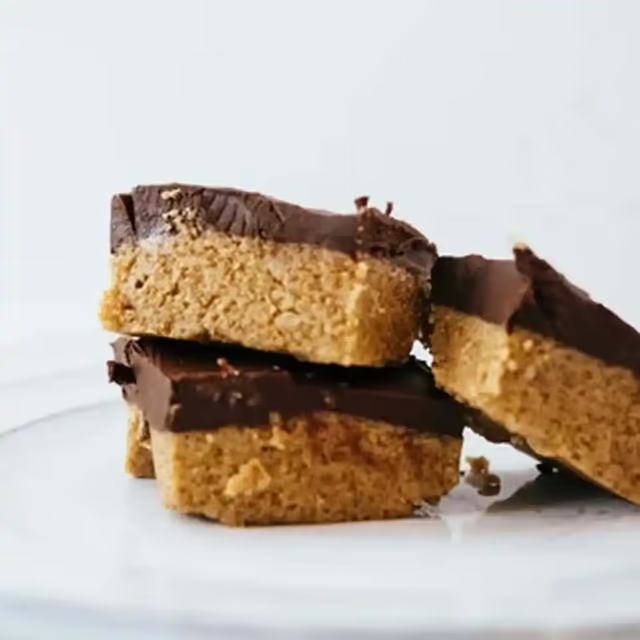
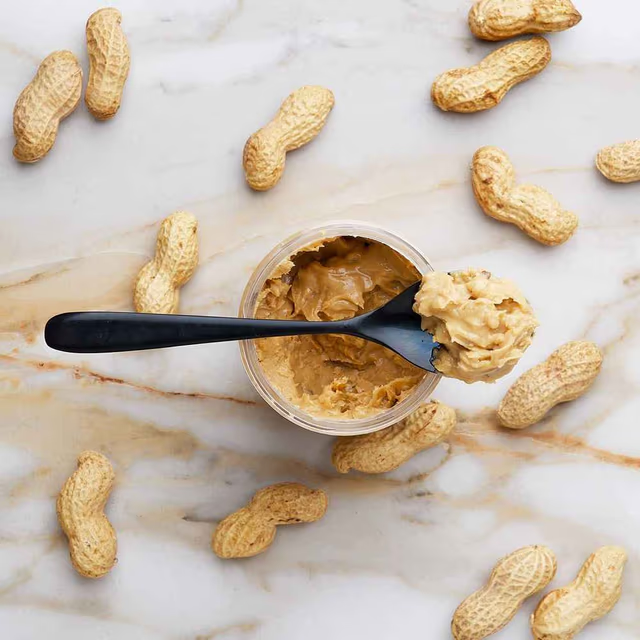
National Peanut Butter Lover's Day hands the calendar over to the jar at the front of the cupboard. Make yourself a proper sandwich with it, or eat a spoonful standing at the counter.

Countdown to the day
--DAYS
--HRS
--MIN
--SEC
Have an update or spot an error?
YEARLY DATEMarch 1
OBSERVED INUnited States
CATEGORYFood
SUBCATEGORYSnacks
ORIGIN

Community Origin

FOUNDING ENTITY
Not documented
FIRST OBSERVED
Not documented
HOW THE HOLIDAY CAME TO BE

The day shows up in peanut butter's centennial year.

No founder, establishing act or primary record has been located for National Peanut Butter Lover's Day. Its earliest traceable listing is an entry in the 1990 edition of Chase's Annual Events, which dates the listing rather than the day.

+ Know the story? Submit a founder Help us complete this holiday
INTRO

What a jar must hold to be called peanut butter

The origin story attached to National Peanut Butter Lover's Day gives the day two parents: the National Peanut Board and a fan club for grown-ups who liked peanut butter. The board did not exist yet. USDA did not issue the order that creates it until the Federal Register of 29 July 1999, and the day's name was already in print by 1990.

So the day itself leaves a thin paper trail. What sits under it is sturdier: the contents of an American jar of peanut butter are fixed by federal regulation, and getting to that rule took the government more than a decade.

The argument was not academic. The public evidentiary hearing alone ran twenty weeks and produced nearly 8,000 pages of transcript, and the disagreement came down to three percentage points of peanut content.

Advertisement
ORIGINS

Peanut Butter Lover’s Day history

INTRODUCTION

In November 1895, from Battle Creek, Michigan, John H. Kellogg filed a patent for something his specification calls nut-butter. His process boiled the peanuts rather than roasting them. It blanched the kernels, cooked them in water for four to six hours, and then poured the water off to strip out what he described as the strong characteristic flavor of the peanut.

The patent record does not converge on one inventor. Marcellus Gilmore Edson of Montreal held an earlier US patent, granted in 1884, for grinding roasted peanuts on surfaces heated to about 100 degrees Fahrenheit. What he was claiming was a confection: one part paste to about seven parts sugar.

CHAPTER 01

What may be sold as peanut butter

By the end of the 1950s the question had moved from who made it to what could be sold under the name. A 1959 FDA press release reported a survey finding that products labeled peanut butter had cut their peanut content by as much as 20 percent, swapping in cheaper hydrogenated and vegetable oils.

FDA proposed a rule requiring 95 percent peanuts. In 1961 it came back with 90 percent and room for sweeteners. Three competitive brands entered the fight: Skippy, Jif and Peter Pan.

The manufacturers took the rule to court and lost. FDA's own history records that a federal appeals court affirmed the agency's order, and that the hearings made clear that strict standards worked to the detriment of both business and consumers.

CHAPTER 02

Where the day comes in

The day surfaces in 1990. That was the year the American peanut trade was selling peanut butter's hundredth birthday, an anniversary the Peanut Advisory Board traced to a St. Louis physician in 1890 whom it did not name.

No founder, sponsor or establishing act for the day has been located in the records searched here. What survives is the listing itself, in the Chase's Annual Events edition for 1990. It is in neither of the two editions before it, both of which the same index carries.

TIMELINE

Timeline

A patent for peanut candy

Marcellus Gilmore Edson of Montreal received a US patent for a peanut paste intended for sweetmeats and candy.

Kellogg patents a nut butter

John H. Kellogg's process for boiled peanut kernels produced what his patent calls nut-butter.

A mill built for the job

Ambrose W. Straub patented a portable mill made specifically for grinding peanuts for butter.

FDA proposes a standard

The agency moved to fix a minimum peanut content after finding labelled products quietly cutting it.

A court settles the recipe

A federal appeals court affirmed the agency's order, closing a rulemaking that had run more than ten years.

The day appears in print

The name turns up in the Chase's Annual Events edition for 1990, the year of the peanut trade's centennial push.

WHY THIS DAY MATTERS

Why We Love National Peanut Butter Lover's Day

LABEL

Miss the federal line and the jar is legally peanut spread.

A spreadable peanut product that does not meet the federal standard, and that is more than 10 percent non-peanut ingredients, cannot be called peanut butter at all; it is sold as peanut spread, with its peanut percentage on the label. That figure must be declared in five percent increments and may never be stated higher than the product actually contains.

MEDICINE

The advice on babies and peanuts reversed

For years the working assumption was that keeping peanuts away from small children would prevent allergy. NIAID says its LEAP trial found that feeding peanut-containing foods to high-risk infants produced an 81 percent relative reduction in the later development of peanut allergy, and the agency published prevention guidelines built on that result in January 2017.

TRADE

Growers pay for the marketing

The federal order behind the National Peanut Board funds peanut promotion with an assessment of one percent of the price growers receive for farmers stock peanuts. First handlers collect it and remit it to the board, which spends it on promotion, research and information programs for consumers and the industry.

AT A GLANCE

Peanut butter, by the federal standard

Standard of identity
21 CFR 164.150
How it is made
shelled, roasted peanuts, ground
Fat ceiling
55 percent of the finished food
Never permitted
artificial flavorings, artificial sweeteners, chemical preservatives, color additives
Stabilizing oils
hydrogenated vegetable oils only
Skins left on
the label must say so, in type at least half the point size

GOOD TO KNOW

Surprising facts about National Peanut Butter Lover's Day

The 1884 peanut paste patent never says peanut butter

The phrase appears nowhere in the text of Edson's 1884 filing. The only place it shows up on the modern patent page is a classification label a computer assigned.

FDA once defined it as peanuts and maybe salt

Asked in 1940 whether glycerin could be added, the agency wrote that peanut butter is generally understood to mean a product consisting solely of ground roasted peanuts, with or without a small quantity of added salt.

The peanut butter mill was patented from Philadelphia

Ambrose W. Straub is usually placed in St. Louis, but his 1903 patent gives his address as Philadelphia, Pennsylvania. The machine it describes is portable, clamps to a support, and is turned by a handle.

A fan club named Gerald Ford among its devotees

The Adult Peanut Butter Lovers Fan Club was about three years old in 1990 and named Madonna, Dan Rather, Kim Basinger, Jack Nicholson and Gerald Ford among its devotees.

The name ran in the reference books for four years

It appears in the Chase's editions for 1990, 1991, 1992 and 1993, and in none of the later volumes the same index carries.

WHY THIS DAY MATTERS

How to Celebrate National Peanut Butter Lover's Day

Look up the patents yourself

The early peanut patents are online and readable in full, drawings and all. Edson's 1884 filing lays out the whole process in plain language.

Read the label before you buy

The federal standard caps what can go in the jar besides peanuts, so the ingredient list is where you see the choices a maker actually made. Put a supermarket brand beside a grind-your-own and read both.

Grind a batch at home

Carver's 1916 bulletin gives the whole method in one line: shell the peanuts, roast them just enough for the skins to slip off, and grind very fine in any sort of mill. Pass it through again if it is still coarse.

Cook it into something savory

The same bulletin puts peanut butter into soups and a brown sauce, not only into sweets. Thin a spoonful into stock and taste what it does to a weeknight dinner.

Test your knowledge

How well do you know National Peanut Butter Lover’s?

1 / 8

What did the 1884 peanut paste patent actually claim as its invention?

Answer

No. It is an unofficial food observance with no legal standing found in the indexes checked, so offices, banks and schools stay open.

COLOPHON

Sources

How we know what’s on this page. References, not endorsements.

13sources
10primary records
11independently dated
Primary records
U.S. Food and Drug Administration2026
21 CFR 164.150, Peanut butter
The federal standard of identity that sets what a jar of peanut butter may contain.
View source
U.S. Food and Drug Administration2026
21 CFR 102.23, Peanut spreads
The labelling rule that renames a jar peanut spread when it misses the standard.
View source
United States Patent Office1884
US Patent 306,727: Manufacture of Peanut-Candy
Marcellus Gilmore Edson's 1884 patent for a peanut paste made for confectionery.
View source
United States Patent Office1897
US Patent 580,787: Process of Preparing Nutmeal
John H. Kellogg's 1897 patent, which boils the kernels before pressing them.
View source
United States Patent Office1903
US Patent 721,651: Mill for Grinding Peanuts for Butter
Ambrose W. Straub's 1903 hand-cranked mill, filed from Philadelphia.
View source
Office of the Federal Register1999-07-29
Peanut Promotion, Research, and Information Order (64 FR 41252)
The 1999 USDA rule creating the National Peanut Board and its grower assessment.
View source
Tuskegee Institute Experiment Station1916
Bulletin No. 31: How to Grow the Peanut and 105 Ways of Preparing It for Human Consumption
George Washington Carver's 1916 bulletin, with peanut butter among its numbered recipes.
View source
National Institute of Allergy and Infectious Diseases2017
Guidelines for Clinicians and Patients for Food Allergy
The LEAP trial result and the 2017 guidelines on preventing peanut allergy.
View source
New England Journal of Medicine2015
Randomized Trial of Peanut Consumption in Infants at Risk for Peanut Allergy
The LEAP trial itself, reporting peanut allergy rates at age five by cohort.
View source
HathiTrust Digital Library
Full-text search of Chase's Annual Events and Chase's Calendar of Events
Which editions of the Chase's reference series carry the day's name.
View source
Additional coverage
FOR MARKETERS & CREATORS

Turn every day into a moment your audience actually shows up for.

8.4M
Monthly readers
5K+
Holidays tracked