Holiday Calendar

Pygmy Hippo Day

Next celebratedThursday, April 8, 2027

Seven photographs from 1,247 camera-trap days were the first ever taken of pygmy hippos in Liberia; awareness of an animal most people will never see is what this date is for.

Countdown to the day
--DAYS
--HRS
--MIN
--SEC
Have an update or spot an error?
YEARLY DATEApril 8
OBSERVED INInternationally
CATEGORYAnimals
SUBCATEGORYWildlife
ORIGIN

Community Origin

FOUNDING ENTITY
Not documented
FIRST OBSERVED
Not documented
HOW THE HOLIDAY CAME TO BE

Listings credit the WWF. The WWF's own site does not.

Holiday listing sites widely credit the World Wildlife Fund with Pygmy Hippo Day, and a second account credits the Pygmy Hippo Foundation, but neither organisation's own website mentions it. No documented founder or formal establishment record has been identified.

+ Know the story? Submit a founder Help us complete this holiday
INTRO

Famous in zoos, nearly invisible in the wild

Researchers looking for pygmy hippos in Liberia's Sapo National Park left cameras running for 1,247 trap days. They came back with seven photographs. It was 2011, and those were the first photographic records of the species ever taken in Liberia.

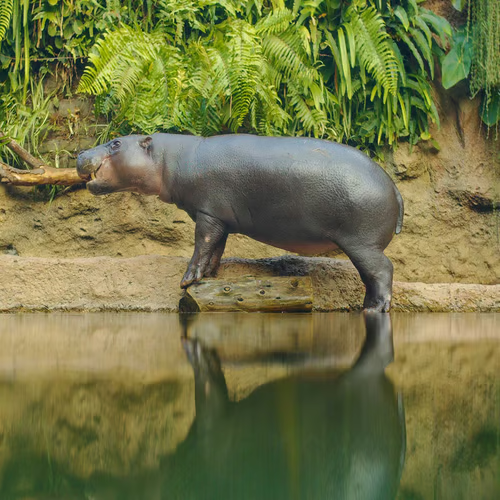
Pygmy Hippo Day, held every April 8, is an awareness date for an animal that most people will never see and many have never heard of. It is not World Hippo Day, which falls on February 15 and belongs to the pygmy hippo's much larger cousin.

Pygmy hippos are nocturnal and solitary, and they keep to swampy forest rather than open river. That combination has kept them out of sight for about as long as anyone has been looking.

Advertisement
ORIGINS

Pygmy Hippo Day history

INTRODUCTION

Europe met the pygmy hippo late, and badly. The first animal shipped north arrived in 1873 and died soon after. Not until 1911 did the species take hold in European zoos, and animals later reached the Bronx Zoo in New York.

That sequence set the pattern the species has never escaped. It became easier to keep than to find, and easier to breed than to count.

CHAPTER 01

A subspecies that slipped away

While zoos were learning to keep it alive, its wild range was quietly thinning. A second subspecies lived in the Niger Delta and is now considered possibly extinct, with the last wild animal there recorded in 1943. No one photographed it, and no one agreed it was gone until decades after it went.

CHAPTER 02

Learning to count what hides

Organized conservation arrived surprisingly recently. The Zoological Society of London's EDGE of Existence programme named the pygmy hippo a priority in 2007. Fieldwork followed in Sapo National Park and the Loma Mountains of Sierra Leone, running until 2012.

The society also led the IUCN regional conservation strategy for the species in 2010. That work was less about protection than about evidence. Before you can defend a population, you have to establish that it is there.

CHAPTER 03

A calf called bouncy pork

Then in July 2024 a calf named Moo Deng was born at Khao Kheow Open Zoo in Thailand, and the arithmetic of attention changed overnight. Her name means bouncy pork. Video of her turned a species most people could not name into a global character, which is roughly the opposite of what a century of quiet fieldwork had managed.

The day itself has no such documented beginning. What it has is observance: conservation groups mark April 8 each year. In 2025 the EcoMarines Foundation posted to raise awareness of the endangered pygmy hippo, which is precisely what the date is for.

WHY THIS DAY MATTERS

Why Pygmy Hippo Day Matters

SCIENCE

The species is studied in captivity because it cannot be watched wild.

Because wild pygmy hippos are seen so rarely, most research on the species is carried out in zoos rather than in the field. That makes captive animals the main source of what science understands about how this hippo actually lives.

ATTENTION

Public interest pays for the animals' care

When Moo Deng went viral, weekday attendance at her zoo climbed from around 800 to over 4,000. The zoo's director said the added income would fund work to improve the animals' lives.

BY THE NUMBERS

Pygmy Hippo Day by the Numbers

2,000-2,500
Pygmy hippos left in the wild
550 lb
Weight of an adult pygmy hippo
18 mph
Pygmy hippo top running speed
42-55 yrs
Pygmy hippo lifespan in captivity

TIMELINE

Timeline

First arrival in Europe

The first pygmy hippo brought north reaches Europe and dies shortly after arriving.

The species takes hold in zoos

European zoos finally establish the animal successfully, and it later reaches the Bronx Zoo.

Last Niger Delta sighting

The last wild animal of the Niger Delta subspecies is recorded, which is now considered possibly extinct.

EDGE names it a priority

The Zoological Society of London identifies the pygmy hippo as a conservation priority.

Regional strategy published

The society leads production of the IUCN regional conservation strategy for the species.

A calf goes viral

Moo Deng is born in Thailand in July and turns the species into an internet phenomenon.

GOOD TO KNOW

Surprising facts about Pygmy Hippo Day

Their skin makes its own sunscreen

Mucus glands across the body secrete a pink substance called hipposudoric acid, thought to be antiseptic and to screen the animal from sun. The skin underneath is actually greenish black.

Their closest living relatives swim oceans

Research in the past decade places hippos closer to whales and dolphins than to any land animal they resemble.

They have four stomach chambers to fill

Camera footage shows pygmy hippos spending at least six hours a day feeding on grasses, roots, stems, fruit, and young leaves.

Calves arrive at under seven kilograms

Pygmy hippo calves are born at roughly 4.5 to 6.2 kilograms. That is a small fraction of the adult weight they eventually reach.

It is roughly a tenth the size of its cousin

The World Wildlife Fund puts an adult pygmy hippo at about one tenth the size of a standard hippopotamus.

GET INVOLVED

How to Observe Pygmy Hippo Day

EDITOR'S PICK

Learn to tell the two hippo species apart

The pygmy hippo is a separate species, not a juvenile common hippo. Knowing the difference makes everything else about its conservation easier to follow.

SUPPORT

Support a field conservation programme

Organizations working in West Africa run habitat protection and monitoring across the species' remaining range. The Resources section below lists established groups doing that work.

VISIT

Visit a zoo that keeps pygmy hippos

Zoo breeding programmes hold much of the documented biology of this animal. A visit is also the only realistic way most people will ever see one.

READ

Read the current conservation assessment

The IUCN specialist group publishes the species' status, range, and principal threats. Ten minutes with the assessment gives a clearer picture than a viral clip.

MARK

Mark the date alongside the groups that observe it

Conservation nonprofits post about the pygmy hippo each April 8, which is how this observance actually circulates. Adding your own post on the date is the simplest way to widen its reach.

GET INVOLVED

Resources and Support

Test your knowledge

How well do you know Pygmy Hippo Day?

1 / 8

How many photographs did the Sapo National Park camera survey produce in 1,247 trap days?

Answer

No. It is an unofficial awareness observance, not a public holiday, so it is a normal working day everywhere it is marked.

FOR MARKETERS & CREATORS

Turn every day into a moment your audience actually shows up for.

8.4M
Monthly readers
5K+
Holidays tracked