March 23
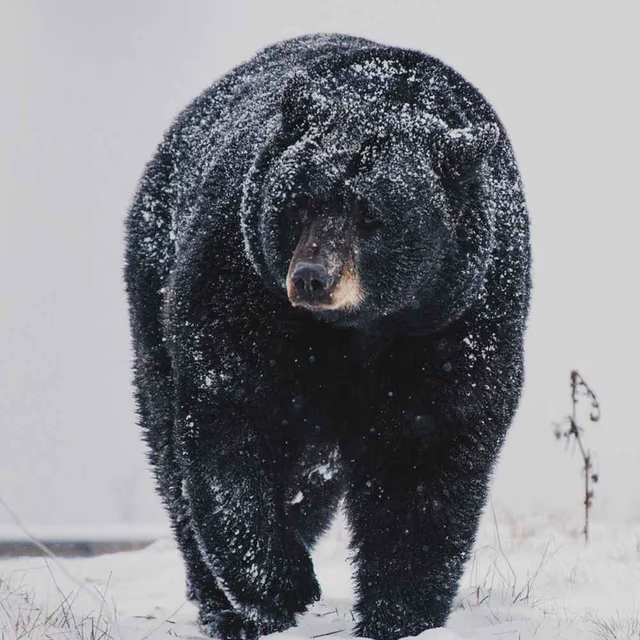
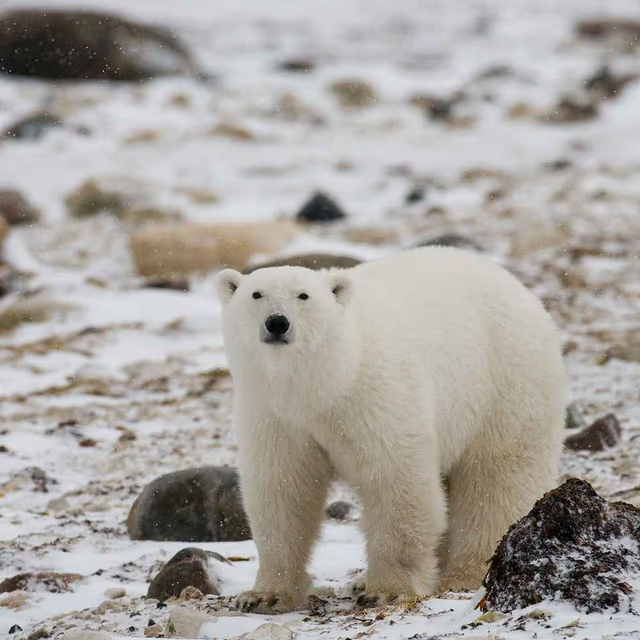
World Bear Day
A conservation observance on March 23 promoting awareness of the world's eight bear species and the ecological threats they face.
Unknown
Community Origin
No documented founder or formal establishment record has been identified. Multiple secondary sources trace the earliest observance to around 1992, attributing it to an unnamed group of conservationists focused on bear welfare.
Introduction
World Bear Day draws attention to eight species that span every continent except Africa, Australia, and Antarctica, yet six of those species are classified as vulnerable or endangered by the IUCN. The sun bear of Southeast Asia, the smallest of all bears at roughly 27 to 65 kilograms, has lost an estimated 35 percent of its population over the past three decades to deforestation and poaching alone.
The observance highlights a group of animals that function as ecological architects. From dispersing berry seeds across subarctic forests to transporting marine-derived nitrogen from salmon carcasses deep into woodland soil, bears shape the health of ecosystems in ways that ripple far beyond their own survival.
World Bear Day History
Bears have occupied a broad ecological niche for millions of years, but their relationship with humans over the past two centuries has pushed several species toward crisis. By the mid-20th century, unregulated hunting, habitat fragmentation, and human-wildlife conflict had decimated populations of brown bears, Asiatic black bears, and other species across multiple continents.
The scientific response began to take shape in 1968, when a small group of biologists formed the International Association for Bear Research and Management (IBA). The organization, which today counts roughly 500 members across more than 40 countries, publishes the peer-reviewed journal Ursus and hosts biennial conferences that bring together field researchers, wildlife managers, and policy advocates.
Legal protection turns the tide
One of the most significant milestones came in 1975, when the U.S. Fish and Wildlife Service listed the grizzly bear as threatened under the Endangered Species Act. At the time, the Greater Yellowstone Ecosystem supported an estimated 136 grizzlies. Decades of habitat protection, food source management, and strict mortality limits pushed that number to approximately 1,030 bears by 2024, making the Yellowstone recovery one of the most cited success stories in large-carnivore conservation.
Bear bile and the fight against exploitation
In Asia, a different threat has consumed conservation attention: the bear bile industry. Bile is extracted from captive bears, primarily Asiatic black bears, for use in traditional medicine. Vietnam outlawed the practice in 2005, when approximately 4,300 bears were held captive. By 2025, sustained rescue campaigns led by organizations like Animals Asia had reduced that number to fewer than 160, a 96 percent decline in two decades.
A conservation day without a named founder
World Bear Day itself traces to around 1992, when secondary sources describe an unnamed group of conservationists establishing the March 23 observance. No primary establishment record, founding organization, or specific individual has been credibly identified. The day has since grown into an annual touchpoint for bear conservation groups, wildlife educators, and sanctuaries to coordinate campaigns and public outreach focused on the survival of all eight bear species.
World Bear Day Timeline
Bear biology association founded
Grizzly bears gain ESA protection
World Bear Day first observed
Vietnam outlaws bear bile farming
Giant panda reclassified as Vulnerable
How to Celebrate World Bear Day
- 1
Support a bear rescue organization
Groups like Animals Asia operate sanctuaries in China and Vietnam that have rescued over 700 bears from bile farms and abusive captivity. Even a small donation contributes to veterinary care, enclosure construction, and long-term rehabilitation for rescued bears.
- 2
Watch a bear research documentary
The BBC's Bears series and the PBS documentary Bears of the Last Frontier follow field biologists tracking grizzly, polar, and black bear populations across remote habitats. These films document real research methods and conservation challenges rather than relying on staged encounters.
- 3
Explore bear ecology through the IBA
The International Association for Bear Research and Management publishes open-access articles, conference proceedings, and its quarterly newsletter International Bear News. Their resources cover everything from human-bear coexistence strategies to the latest population surveys for each of the eight species.
- 4
Reduce attractants in bear country
If you live or recreate in bear habitat, use this day to secure garbage bins, take down bird feeders for the season, and install bear-proof food storage at campsites. Reducing attractants is the single most effective step for preventing human-bear conflicts that often result in the lethal removal of habituated bears.
- 5
Visit a bear sanctuary or accredited zoo
Facilities accredited by the Association of Zoos and Aquariums fund Species Survival Plans for sun bears, Andean bears, and other threatened species. Many sanctuaries and zoos host special World Bear Day programming, including keeper talks and behind-the-scenes tours of bear habitats.
Why We Love World Bear Day
- A
Six of eight bear species face extinction risk
The IUCN classifies the polar bear, sun bear, sloth bear, Asiatic black bear, Andean bear, and giant panda as Vulnerable, with several populations in continued decline. World Bear Day provides a concentrated moment for conservation organizations to publicize these status assessments and direct funding toward species-specific recovery programs.
- B
Bears engineer forest ecosystems through nutrient cycling
In coastal regions of Alaska and British Columbia, bears carry salmon carcasses into forests, depositing marine-derived nitrogen that measurably accelerates tree growth. In berry-producing landscapes, brown and black bears function as primary seed dispersers, spreading hundreds of thousands of seeds per square kilometer per hour and outperforming birds in that ecological role.
- C
It confronts an active wildlife exploitation crisis
An estimated 12,000 bears remain confined in bile farms across five Asian countries, held in metal cages for the extraction of ursodeoxycholic acid. The observance amplifies campaigns by organizations like Animals Asia and FOUR PAWS that have driven a 96 percent reduction in Vietnam's captive bear population since 2005.
Holiday Dates
| Year | Date | Day |
|---|---|---|
| 2023 | Thursday | |
| 2024 | Saturday | |
| 2025 | Sunday | |
| 2026 | Monday | |
| 2027 | Tuesday |